Why do I bite my nails?
If you wanted a room of undergraduates to bite their nails, the research suggests two methods: leave them alone, or hand them difficult maths. A university psychology department tried both on 40 students who said they bit their nails. Each student went through four settings in random order: left alone, solving maths problems, being told off for biting, and holding a continuous conversation. Biting was most frequent in the first two and least frequent in the last two 1.
We report the telling-off without recommending it.
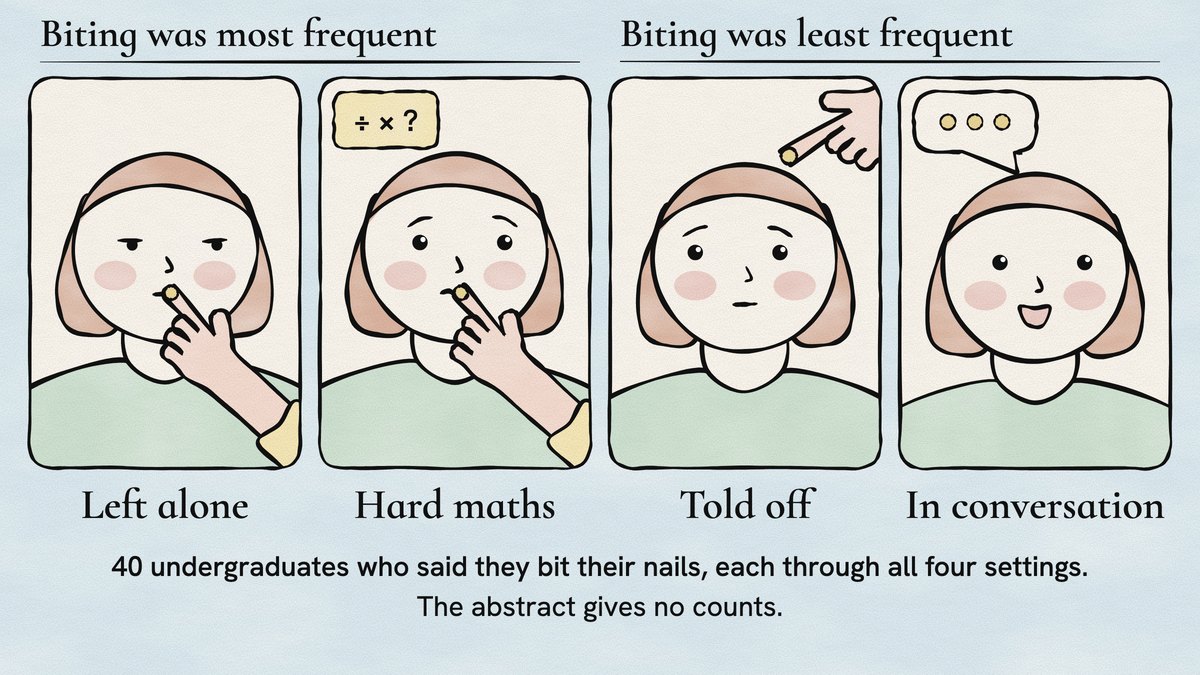
That study is small, the abstract gives no counts, and a lab isn't a sofa. It is still one of the most direct looks at your question, and its answer differs from the one most of us grew up with.
What do boredom and hard maths have in common?
Having nothing to do and having something you can't do look like opposites, yet nail biting seems to respond to both. A second lab study points the same way. It compared 24 people with hand habits and 23 without, in conditions designed to bring on boredom or frustration, stress and relaxation. The group with hand habits reported a stronger urge in the boredom and frustration condition than in relaxation. The stress condition didn't produce that difference. The authors single out boredom, frustration and impatience as triggers 2.
Two cautions. These were reported urges, not observed bites, and the abstract doesn't break the group down by habit, so this isn't a nail biting study on its own.
Impatience may be the most useful of those three words. This next part is our reading and goes beyond the data. A stalled task, a dull call and the slow middle of a film all leave you waiting for something to change, and your hands get there first.
Is nail biting a nervous habit?
For nail biting, "nervous habit" is a label with mixed support. The 47-person result above leans against it, and in the first study the peaks came from boredom and frustration 1.
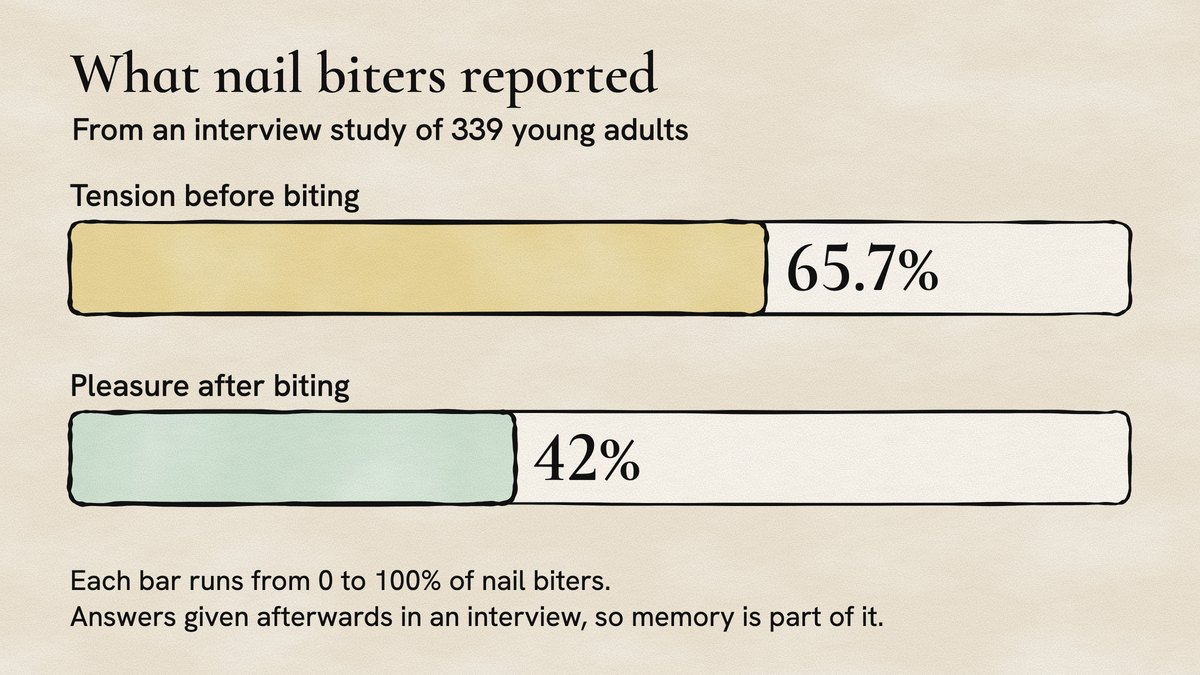
Self-report pulls the other way. Among 339 young adults interviewed with a structured questionnaire, 65.7% of nail biters reported tension before biting 3. Those findings may be less opposed than they look, because frustration is tense too. That is only our suggestion.
A 1996 paper asked the question in its title: are persons with nervous habit nervous? Researchers secretly filmed 44 people in anxious, bored and neutral conditions. Hair and face manipulation rose in the anxiety condition, and object manipulation rose in the bored one 4. The abstract doesn't list nail biting among the habits scored, so it is only indirect. It hints that different hand habits may answer to different moods, which makes one explanation for every fidget unlikely.
Does biting feel good?
Fewer than half of the nail biters in the interview study reported pleasure afterwards: 42%, against the 65.7% who reported tension beforehand 3. If enjoyment alone kept the habit going, you might expect those numbers the other way round. Memory is a shaky witness, so hold that lightly.
Why do I only notice afterwards?
Nail biting may often arrive as news, after the fact, though nothing here measured when people notice. In the same interview study, 92.2% of subjects, most likely meaning the nail biters, described it as an automatic behaviour 3.
Habit research offers a possible mechanism, and applying it to nails is our inference. In Wood and Neal's model, habits grow from gradual learning between a response and its setting, such as a physical place or the action just before it. Once formed, the setting triggers the response "without a mediating goal" 5. On that account, a habit can outlive whatever started it. The reason you bit your nails at fourteen and the reason you bit them during today's meeting may have nothing to do with each other.
Are nail biters perfectionists?
The perfectionist explanation runs ahead of its evidence. In the 47-person lab study, the group with hand habits scored higher on what the authors call a maladaptive planning style, a term the abstract ties to high standards 2. That is a link in a small mixed group, and it doesn't show that high standards cause anyone to bite.
What can't these studies tell you?
Nothing here explains why you, personally, started. The direct evidence comes from 40 undergraduates and 47 people in labs, plus one interview study of young adults, and we read those as abstracts. They describe groups, and your own triggers may look nothing like theirs.
What can you do with this today?
- Next time you catch yourself biting, ask whether you were bored, stuck or something else. This is common sense, we found no test of it, and it costs one second.
- Before your next dull call or hard task, decide what your hands will do instead. Practising another movement has small studies behind it, with mixed results 6. The details are in how to stop biting your nails as an adult.
Most of this happens while your mind is on the film or the spreadsheet, which is why we built Mooo. Leave it running while you work or watch, and a soft cowbell rings when your hand stays near your face, so you hear about it at the time.
Sources
- Williams TI, Rose R, Chisholm S (2007). What is the function of nail biting: an analog assessment study. Behaviour Research and Therapy 45(5):989-995. PubMed
- Roberts S, O'Connor K, Aardema F, Bélanger C (2015). The impact of emotions on body-Focused repetitive behaviors: evidence from a non-treatment-seeking sample. Journal of Behavior Therapy and Experimental Psychiatry 46:189-197. PubMed
- Pacan P, Grzesiak M, Reich A, Kantorska-Janiec M, Szepietowski JC (2014). Onychophagia and onychotillomania: prevalence, clinical picture and comorbidities. Acta Dermato-Venereologica 94(1):67-71. PubMed
- Woods DW, Miltenberger RG (1996). Are persons with nervous habit nervous? A preliminary examination of habit function in a nonreferred population. Journal of Applied Behavior Analysis 29(2):259-261. PubMed
- Wood W, Neal DT (2007). A new look at habits and the habit-goal interface. Psychological Review 114(4):843-863. PubMed
- Silber KP, Haynes CE (1992). Treating nailbiting: a comparative analysis of mild aversion and competing response therapies. Behaviour Research and Therapy 30(1):15-22. PubMed