How to stop biting your nails as an adult
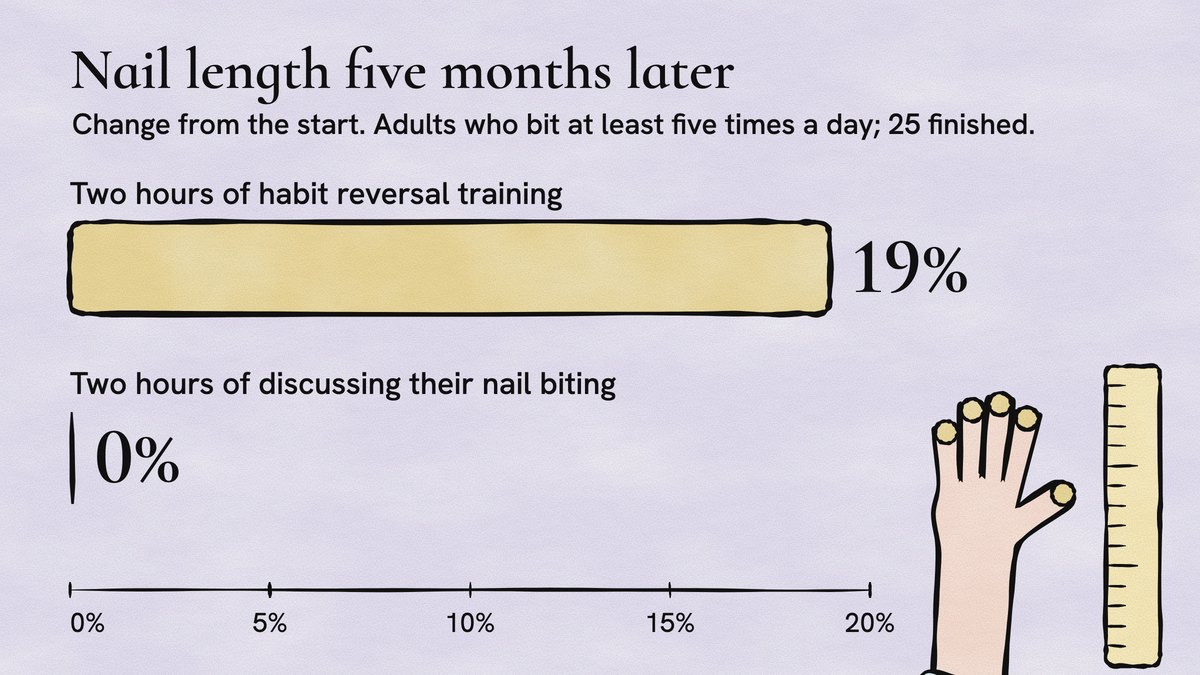
In a 2003 trial, adults who bit their nails at least five times a day got two hours of training, spread over three sessions. Five months later their nails were still 19% longer than when they began. A comparison group spent the same two hours discussing their nail biting, and their nails showed no gain at all 1.
Two hours is about one film. The trial was small and its people bit far more than most, so it promises nobody anything. It does suggest where to put the effort: the group that talked about the habit stayed where it was, and the group that trained for it grew nails.
Do adults really stop biting their nails?
In one group of young adults, former nail biters outnumbered current ones. Among 339 people interviewed with a structured questionnaire, 19.2% were active nail biters and 27.7% were past nail biters 2.
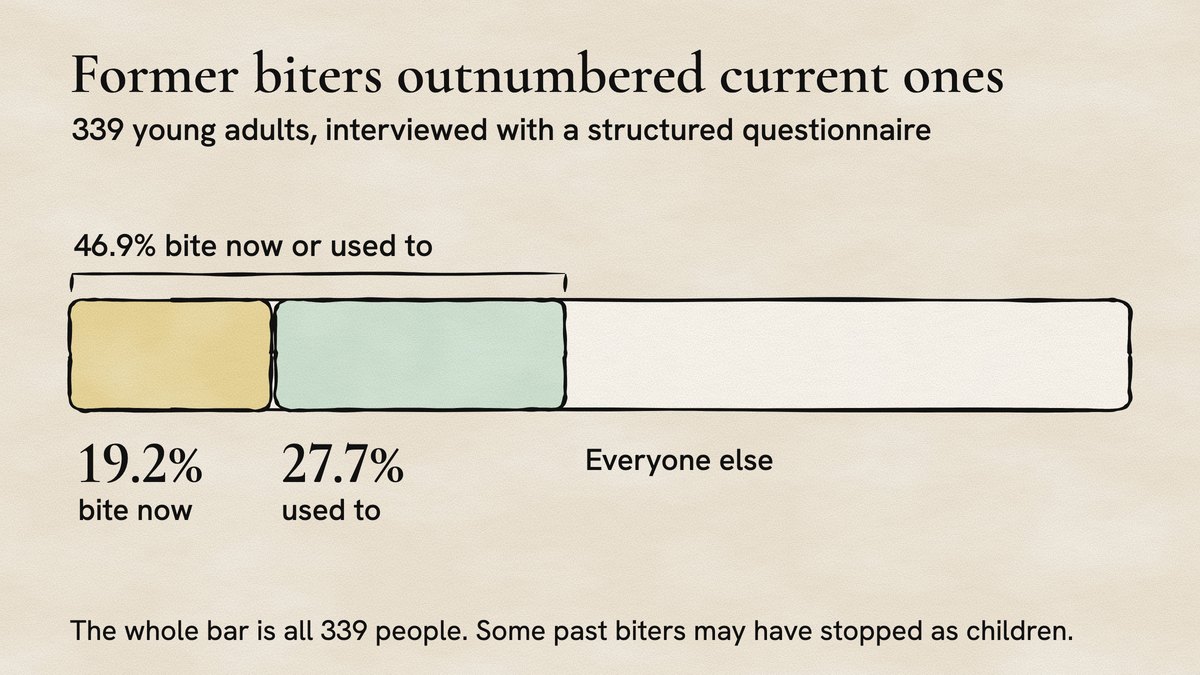
Those two add up to the 46.9% the paper reports, so that figure counts anyone who bites now or used to. The abstract's only definition is chronic nail biting behaviour, with no threshold for how often. It doesn't say how the group was chosen or when the former biters stopped, and some may have stopped as children.
The 2003 trial used a far stricter definition: at least five times a day, nearly every day, for at least four weeks, with physical damage or social impairment 1. Any figure for how many adults bite their nails means little until you know which definition it belongs to.
Why doesn't deciding to stop work?
A habit doesn't check with your goals before it runs. In Wood and Neal's model, the setting triggers a formed habit "without a mediating goal", and such links "do not shift appreciably" with current goals or the occasional effort to do otherwise 3.
The model covers habits in general, so applying it to nails is our inference. It fits what biters report: in the interview study, 92.2% of subjects described nail biting as automatic 2. The film, the stalled email and the long call do the asking, and your hand answers before you've been consulted. A firm decision changes your goal. On this model, the link between the sofa and your hand stays where it was.
What happens in those two hours?
Habit reversal replaces resolve with rehearsal. It has three parts: awareness training, competing response training and social support 1. A competing response is something else your hands do, at the first urge or as soon as you catch yourself biting 4.
Thirty adults were assigned and 25 finished, 13 in one group and 12 in the other. They were heavy biters and they learned the method in sessions, so a do-it-yourself version isn't what was tested. The outcome was nail length, which is a different thing from a count of bites 1.
Does bitter nail polish work?
Bitter polish has the steadiest record here, which still only means two small studies. In the first, 21 people spent four weeks in groups of seven. One group painted a bitter substance on their nails, one used a competing response, and one only monitored their own biting. Both active groups also monitored, and both gained significant nail length, with the competing response doing best 5.
A later replication in 45 people came out differently. The bitter substance reached significance and the competing response just missed it 4. Which of the two is better remains open.
Does keeping track of your biting help?
Keeping track, on its own, brought no significant improvement in either study 45. Studies this small can miss a real effect, so this falls short of proof that tracking is useless.
Diary studies of bad habits in general found that people controlled them best through vigilant monitoring, which the authors describe as thinking "don't do it" and watching carefully for slipups. A follow-up experiment found this raised control while the habit's memory stayed as strong as before 6. The abstract doesn't single out hand habits, and the diaries were self-reported.
Read together, these suggest to us that noticing gets you to the moment, and you still need something ready when you arrive.
Is there a self-help method?
We found one self-help exercise tested in a randomised trial of nail biting alone. It is called decoupling, a motor exercise that interrupts and rearranges the movement. Seventy-two people with excessive nail biting, recruited through self-help forums, were randomised to decoupling or muscle relaxation and reassessed after four weeks. The decoupling group did significantly better at withstanding the urge, though the main measure reached only trend level 7. A later randomised trial compared three self-help methods across several hand habits 10, and we haven't covered it here.
The technique was new, the abstract notes methodological limitations, and it doesn't spell out the movement, so we won't guess it here. Worth knowing about, too early to lean on.
How long does it take?
We found no study that measures how long it takes to lose a nail biting habit. The 21 days you may have heard about has no support in the research we read. In one study that began with 96 volunteers, the time to get close to peak automaticity ranged from 18 to 254 days, with the longest times estimated from a curve 8. Those people were building a new daily behaviour, so don't apply the numbers to dropping an old one. The longest follow-up in the nail studies here is five months 1.
What doesn't the research show?
The trials above are small: 25 finishers, then 21, 45 and 72 people. We found no trial run in an office. We read these papers as abstracts, so where a detail is missing above, that is why. None of it predicts what will happen for you.
What can you try today?
Each step says what stands behind it.
- Measure one nail and write the number down. Nail length was the outcome in the trials 15, so you are borrowing their ruler. It won't change your nails by itself, but it is more honest than memory.
- Name your two worst situations. Among 40 undergraduates, biting peaked when they were bored or stuck on a hard problem 9, and yours may differ. Naming them is our common-sense version of awareness training. The abstract doesn't say how that training was taught.
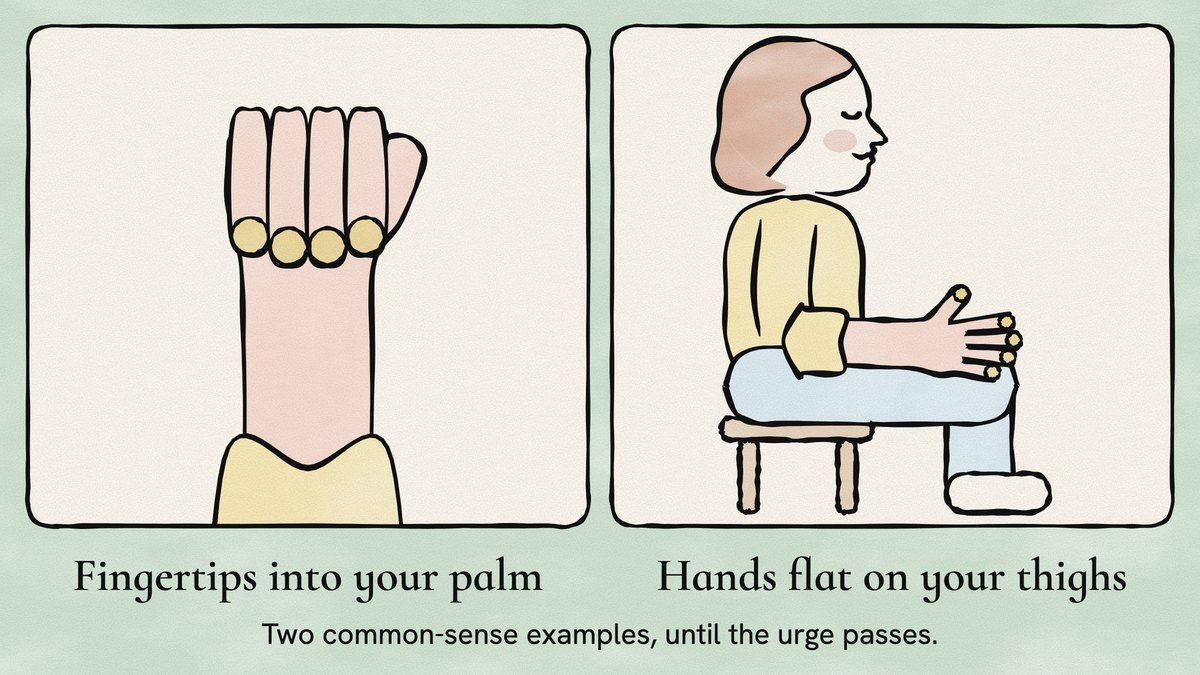
- Choose something for your hands to do and rehearse it now. The competing response has been tested, with mixed results 145. The abstracts don't name a movement, so this example is common sense: press your fingertips into your palm, or rest your hands flat on your thighs, until the urge passes.
- Paint on a bitter polish if you like the idea, and keep monitoring as you do. That pairing is what the two small studies tested 45.
- Tell one person. Social support was part of habit reversal 1. Asking a friend to mention it kindly when they see it is our guess at what helps, and we found no test of it.
- Keep a nail file where you tend to bite, so rough edges get filed. This is pure common sense, with no study behind it.
If biting hurts or is getting you down, a doctor can do more than a blog can.
Most of this happens without noticing, so we built something that notices for you: while you work or watch a film, Mooo rings a soft cowbell when your hand stays near your face. What your hands do next is still up to you.
Sources
- Twohig MP, Woods DW, Marcks BA, Teng EJ (2003). Evaluating the efficacy of habit reversal: comparison with a placebo control. The Journal of Clinical Psychiatry 64(1):40-48. PubMed
- Pacan P, Grzesiak M, Reich A, Kantorska-Janiec M, Szepietowski JC (2014). Onychophagia and onychotillomania: prevalence, clinical picture and comorbidities. Acta Dermato-Venereologica 94(1):67-71. PubMed
- Wood W, Neal DT (2007). A new look at habits and the habit-goal interface. Psychological Review 114(4):843-863. PubMed
- Allen KW (1996). Chronic nailbiting: a controlled comparison of competing response and mild aversion treatments. Behaviour Research and Therapy 34(3):269-272. PubMed
- Silber KP, Haynes CE (1992). Treating nailbiting: a comparative analysis of mild aversion and competing response therapies. Behaviour Research and Therapy 30(1):15-22. PubMed
- Quinn JM, Pascoe A, Wood W, Neal DT (2010). Can't control yourself? Monitor those bad habits. Personality & Social Psychology Bulletin 36(4):499-511. PubMed
- Moritz S, Treszl A, Rufer M (2011). A randomized controlled trial of a novel self-help technique for impulse control disorders: a study on nail-biting. Behavior Modification 35(5):468-485. PubMed
- Lally P, van Jaarsveld CHM, Potts HWW, Wardle J (2010). How are habits formed: Modelling habit formation in the real world. European Journal of Social Psychology 40(6):998-1009. Not indexed in PubMed. Publisher record
- Williams TI, Rose R, Chisholm S (2007). What is the function of nail biting: an analog assessment study. Behaviour Research and Therapy 45(5):989-995. PubMed
- Moritz S, Penney D, Ahmed K, Schmotz S (2022). A head-to-head comparison of three self-help techniques to reduce body-focused repetitive behaviors. Behavior Modification 46(4):894-912. PubMed