Why you shouldn't touch your face: what the research shows
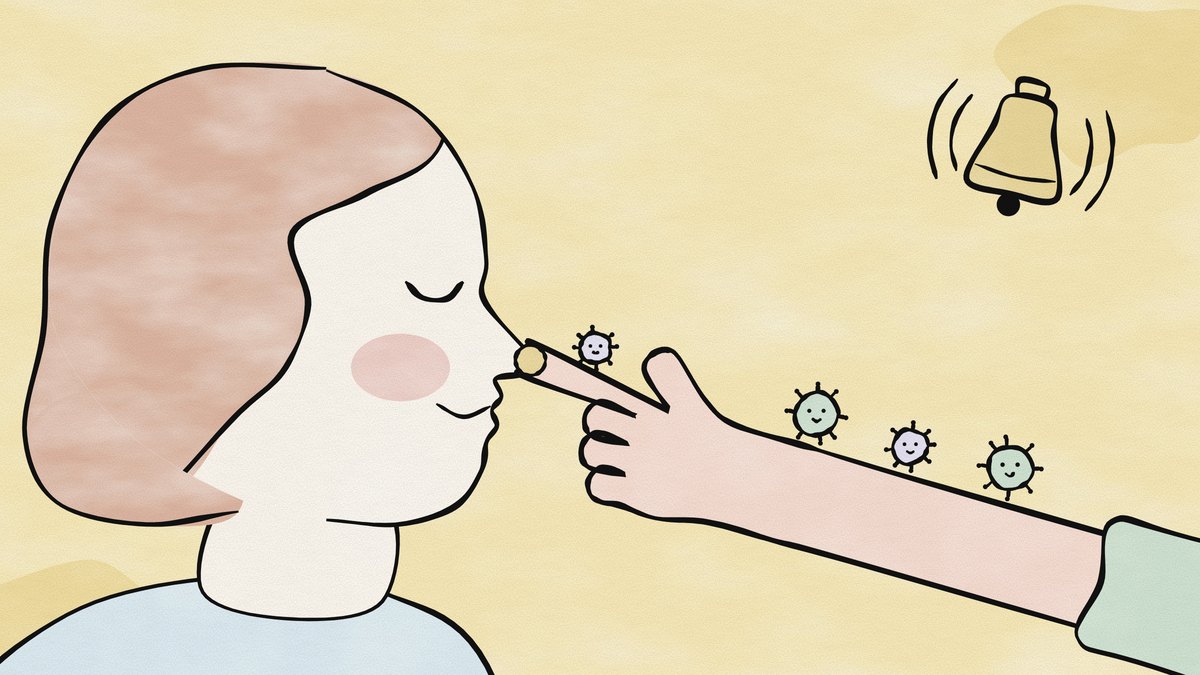
Ten seconds of hand contact was enough to move virus. In a 1978 lab experiment, rhinovirus on the hands of deliberately infected volunteers reached the fingers of other volunteers in 20 of 28 contacts, or 71% 1. Of 15 hand-contact exposures, 11 started an infection. Exposure to large airborne particles infected 1 of 12, and small particles infected none of 10 1.
Forty-five years later, a systematic review of 25 studies came down on the side of air 2.
Both findings can stand, because they answer different questions. The experiment was a small lab set-up, and its abstract doesn't say how the virus got from fingers to nose or eyes, so it can't stand for an ordinary day. It showed that a route can work. The review asked which route does most of the work in real rooms. Any case for keeping your hands away from your face has to survive both.
What is established?
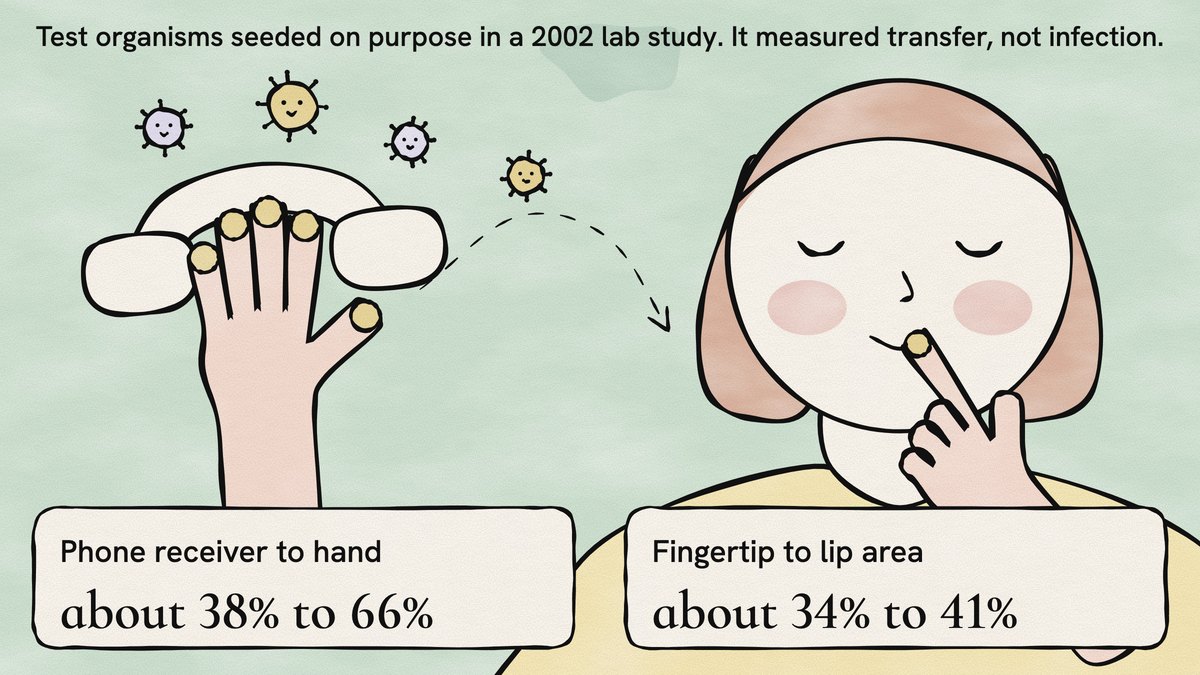
Hands move germs from objects to faces, and that part isn't in doubt. In a 2002 lab study, volunteers handled household objects seeded with test organisms. Between about 38% and 66% of the organisms moved from a phone receiver to the hand, and between about 28% and 40% from a kitchen faucet. From porous objects it was under 0.01% 3. When fingertips carrying the organisms were held to the lip area, about 34% to 41% moved across 3. Those figures describe transfer and say nothing about infection, and these were objects seeded on purpose.
For many pathogens, the eyes, nose and mouth are the route into the body 9. WHO's flu fact sheet names exactly those three, saying to "avoid touching your eyes, nose or mouth", and notes that the virus "can also be spread by hands contaminated with influenza viruses" 4.
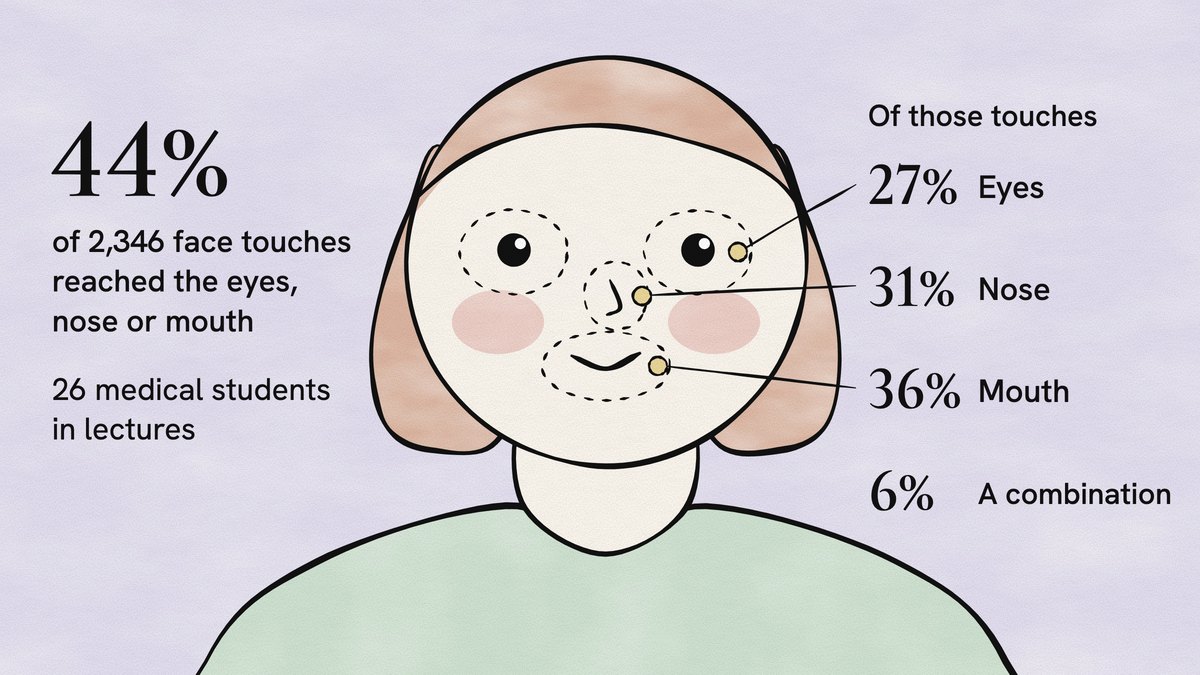
We reach those places often. Of the 2,346 face touches counted among 26 medical students in lectures, 44% landed on the eyes, nose or mouth. The mouth took 36% of those, the nose 31% and the eyes 27%, and 6% were a combination 5. Ten student volunteers doing office-type work alone made 15.7 contacts an hour with their eyes, nostrils and lips 6. Neither study measured infection.
Is touching your face how colds spread?
For rhinovirus, a cause of the common cold, air probably matters more than hands. The 2023 review found "low evidence" that hands and surfaces followed by self-inoculation are the dominant route in real-life indoor settings, and "moderate evidence" that airborne transmission is the major one 2. Hands stay on the list as a possible route, and probably the smaller one. The review covers this one virus family.
COVID-19 tells a similar story, at least as of the CDC's science brief updated on April 5, 2021, an archived document about one virus. It calls exposure to respiratory droplets the principal mode of infection, and puts the risk of each contact with a contaminated surface at generally less than 1 in 10,000 7.
Does touching your face less mean fewer infections?
We found no trial showing that touching your face less means fewer infections. The largest trial we know of on reducing face touching randomised 1,090 adults who read and write Chinese, recruited through social media, to a brief mindfulness exercise or a wait-list. They counted their own touches for 60 minutes before and after, and the exercise group reported a slightly larger drop 8. That trial measured touching and never measured infection.
Models don't fill the gap either. The infection example in that office-work study comes from a mathematical model, and nobody's infections were observed 6. Hand hygiene has better support, since the CDC brief says it "has been associated with lower risk of infection" 7. Washing your hands and touching your face are different behaviours, though, and evidence for one doesn't carry over to the other.
A missing trial leaves the size of the effect unknown. It could be useful or it could be negligible, and as far as we can find, nobody has measured it.
So is it still worth keeping your hands away from your face?
Keeping your hands away from your face is a cheap precaution with a plausible mechanism and an unknown payoff. WHO still lists it among its other ways to prevent flu, after vaccination 4. It is cheap in money, anyway. It costs more in attention: among 569 Canadian adults, automaticity was the strongest predictor of how much they later reported touching their eyes, nose or mouth 9.
Wash your hands first. Of the two habits, this is the one the CDC brief links with lower risk 7. A touch can only carry what is already on your hand.
Save your vigilance for when it counts. The route needs a germ to carry, so the time to mind your eyes, nose and mouth is when a cold or flu is going around you. That is our reasoning from the mechanism, and no study here tested it.
Keep the air in mind. For rhinovirus indoors, clean hands probably cover the smaller part of the risk 2.
Go easy on yourself. A single touch is no cause for alarm. Most of the students' touches, 56%, never reached the eyes, nose or mouth at all 5.
We can't promise that touching your face less will spare you a single cold, and neither can the research. What we can offer is smaller. Mooo, the app we built, rings a soft cowbell when your hand stays near your face while you work or watch a film. What you do about it is up to you.
Sources
- Gwaltney JM, Moskalski PB, Hendley JO (1978). Hand-to-hand transmission of rhinovirus colds. Annals of Internal Medicine 88(4):463-467. PubMed
- Andrup L, Krogfelt KA, Hansen KS, Madsen AM (2023). Transmission route of rhinovirus - the causative agent for common cold. A systematic review. American Journal of Infection Control 51(8):938-957. PubMed
- Rusin P, Maxwell S, Gerba C (2002). Comparative surface-to-hand and fingertip-to-mouth transfer efficiency of gram-positive bacteria, gram-negative bacteria, and phage. Journal of Applied Microbiology 93(4):585-592. PubMed
- World Health Organization. Influenza (seasonal). Fact sheet, 28 February 2025. WHO
- Kwok YL, Gralton J, McLaws ML (2015). Face touching: a frequent habit that has implications for hand hygiene. American Journal of Infection Control 43(2):112-114. PubMed
- Nicas M, Best D (2008). A study quantifying the hand-to-face contact rate and its potential application to predicting respiratory tract infection. Journal of Occupational and Environmental Hygiene 5(6):347-352. PubMed
- Centers for Disease Control and Prevention. Science Brief: SARS-CoV-2 and Surface (Fomite) Transmission for Indoor Community Environments. Updated April 5, 2021, archived page. CDC
- Tang J, Wang L, Luo T, Wu S, Wu Z, Chen J, Pan C, Wang Y, Liu Y, Luo Q, Guo X, Xie L, Zhou J, Sun Y, Chen W, Liao Y (2022). Effectiveness of a Brief Mindfulness-Based Intervention of "STOP touching your face" During the COVID-19 Pandemic: a Randomized Controlled Trial. Mindfulness 13(12):3123-3133. PubMed
- Wilson M, van Allen ZM, Grimshaw JM, Brehaut JC, Durand A, Lalonde JF, Manuel DG, Michie S, West R, Presseau J (2023). Reducing touching eyes, nose and mouth ('T-zone') to reduce the spread of infectious disease: A prospective study of motivational, volitional and non-reflective predictors. British Journal of Health Psychology 28(4):893-913. PubMed