Why do I touch my face when I talk?
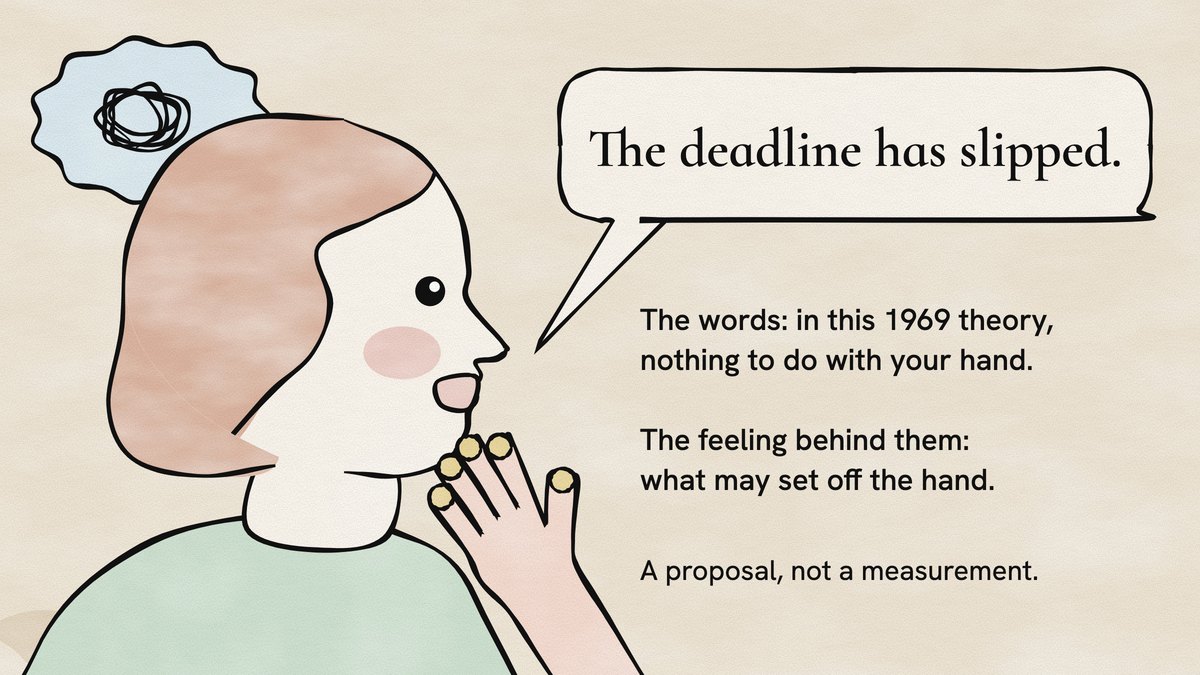
The researchers who named this gesture did not think it belonged to speech. Writing in 1969, Ekman and Friesen said that self-adaptors, a category that includes hands touching the face, "have no intrinsic relationship to speech" 1. In the same sentence they left a door open. These movements, they wrote, "may be triggered by, or related to, the motives, or affects, which are being verbalized" 1.
Affects are feelings. On that view, if your hand goes up as you tell a client the deadline has slipped, the trigger would be how you feel about the news. The grammar has nothing to do with it.
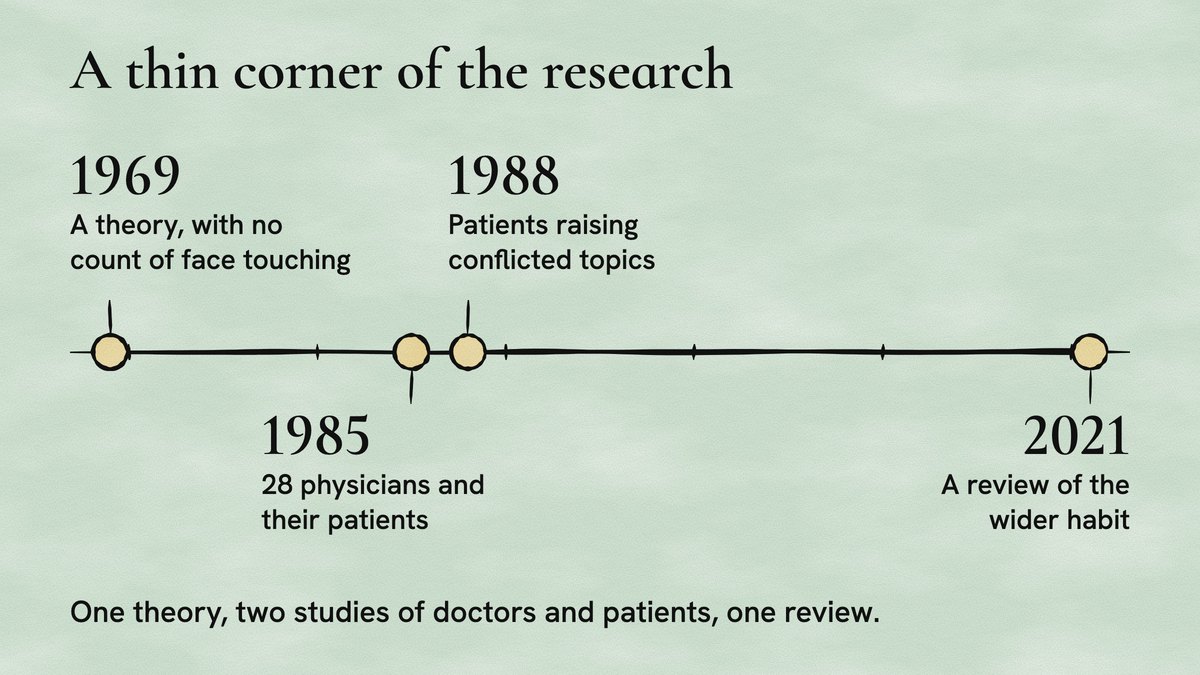
This is a thin corner of the research. This post rests on one theory from 1969 and two studies of doctors and patients from the 1980s, and neither abstract reports results in numbers. We found little modern gesture research that isolates face touching during speech.
What is a self-adaptor?
A self-adaptor is a touch to your own body that nobody is meant to read. Ekman and Friesen's paper sets out five categories of nonverbal behaviour, and adaptors are one of them. They describe adaptors in adults as "habitual, not intended to transmit a message, and usually without awareness" 1. So in this theory the hand on your chin isn't telling the other person anything on purpose, and you may not know it is there.
This was a proposal. The authors called adaptors the category that "involves the most speculation" 1, and the pages we read report no count of face touching.
Does talking itself set it off?
One study suggests that thinking and speaking play a part. In 1985, Harrigan studied medical interviews between 28 physicians and their patients, looking at the types of self-touching, what was being said at the time and where each touch fell in the flow of speech. The results, the abstract says, support the idea that self-touching happens "in relation to information processing and production, in addition to negative affect" 2. In other words, self-touch went along with working out what to say and saying it, as well as with unpleasant feelings.
By our reading, that goes further than the 1969 theory, which tied these movements to the feeling behind the words. It has real limits. The abstract gives no numbers, the setting is one kind of conversation, and it doesn't say the touches were on the face, so we call them self-touch here. It found a link and can't tell us why.
A 1988 study points towards feeling. It looked at patients raising emotionally conflicted topics with family doctors, and "hand-to-body self-touching occurred significantly more often during presentation of anxiety-producing topics", while gestures that illustrate speech didn't differ 3. The abstract gives no sample size and no numbers, and it says hand-to-body, so we can't say these touches were on the face. Harrigan is one of its authors, so it isn't independent of the 1985 study. By our reading, it fits the 1969 idea that the feeling behind the words can set off the hand, and it shows a link without showing why.
A 2021 review adds some support from a distance. It reports that face touches seem to increase in "socially, emotionally as well as cognitively challenging situations" 4. A conversation can be all three at once, which may be why talking feels like a trigger. That last step is our reading, and nobody we found has tested it.
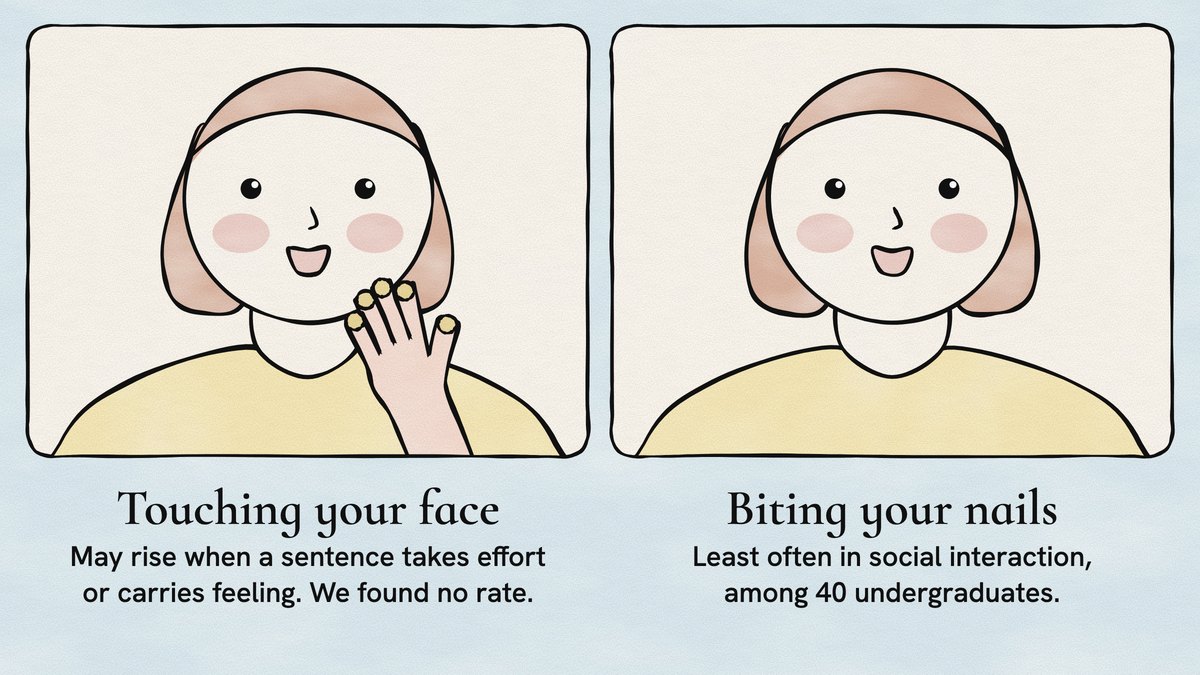
Put together, the picture is plausible and unproven: a hand rises when a sentence takes effort or carries feeling.
Does every hand habit rise when we talk?
Nail biting seems to drop off during conversation. In a study of 40 undergraduates who bit their nails, biting was most common when they were bored or frustrated, and it occurred "least often when people are engaged in social interaction" 5. Our guess is that a mouth in use is a poor place for fingers. Nail biting is a different habit from touching your face, so the two findings don't clash. They do show that talking doesn't push all hands in one direction.
What does it mean when someone touches their face while talking?
Ekman and Friesen thought a touch to the face could tell an observer something, and they also thought reading it was unreliable. They wrote that "probably the easiest self-adaptors to decode are ones in which the hands touch the face" and called such touches "a particularly rich source of information" 1. On the same page they called decoding self-adaptors "difficult, often speculative and uncertain" 1. That makes a touch to the face the easiest item in a hard category.
Nothing we read tested whether a touch reveals anything about honesty. If you have been worrying about what your hand says about you, the theory that named the gesture holds that you didn't mean to say anything, and that any reading of it is uncertain.
What doesn't the research show?
The sources here give no rate of face touching while speaking and no comparison with sitting in silence. They can't say whether the habit changes on calls, with strangers or in a second language. A large modern study of face touching in everyday conversation would tell us more than anything here.
Our guess is that your attention is on your words at the time, so your hand gets very little of it. We built Mooo to pay that attention for you, at work or during a film. It rings a soft cowbell when your hand stays near your face.
Sources
- Ekman P, Friesen WV (1969). The repertoire of nonverbal behavior: Categories, origins, usage, and coding. Semiotica 1(1):49-98. Not indexed in PubMed. DOI
- Harrigan JA (1985). Self-touching as an indicator of underlying affect and language processes. Social Science & Medicine 20(11):1161-1168. PubMed
- Shreve EG, Harrigan JA, Kues JR, Kagas DK (1988). Nonverbal expressions of anxiety in physician-patient interactions. Psychiatry 51(4):378-384. PubMed
- Spille JL, Grunwald M, Martin S, Mueller SM (2021). Stop touching your face! A systematic review of triggers, characteristics, regulatory functions and neuro-physiology of facial self touch. Neuroscience and Biobehavioral Reviews 128:102-116. PubMed
- Williams TI, Rose R, Chisholm S (2007). What is the function of nail biting: an analog assessment study. Behaviour Research and Therapy 45(5):989-995. PubMed