How to stop touching your face at work
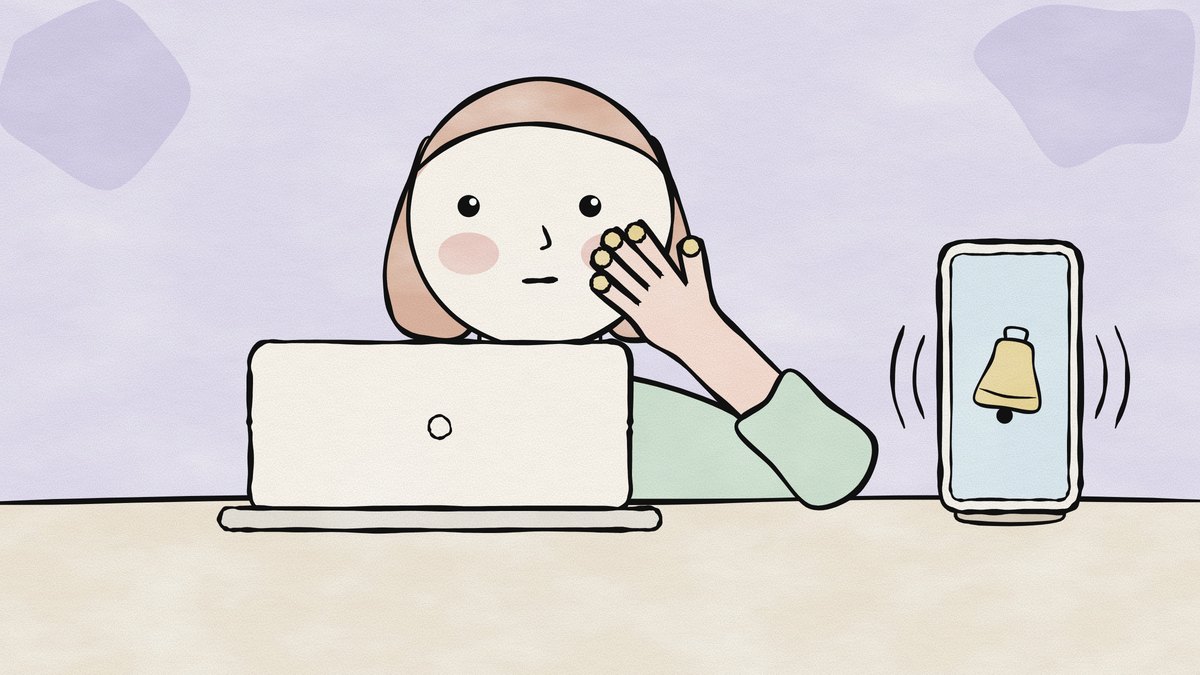
Ten students once spent three hours alone at desks doing office-type work, on camera. They had been told the tapes were for counting touches to a variety of surfaces. Over those three hours, one of them touched their eyes, nostrils or lips 3 times. Another did it 104 times 1.
The group averaged 15.7 contacts an hour 1, but the gap between those two people is the more useful number. Your own count could sit near either end, and until you count, you can't know which.
A real workplace showed a similar spread. At 7 family medicine offices in the Cincinnati area, observers watched 31 clinicians and 48 staff. They touched their eyes, nose or mouth a mean of 19 times in 2 hours, and individuals ranged from 0 to 105 2.
Can you stop just by deciding to?
Deciding to touch your face less may change your intentions more than your hands. A study followed Canadian adults for 2 weeks, and 569 answered the follow-up. How automatic the behaviour had become was the strongest predictor of what they reported doing 3. The authors suggest that reasoning with yourself may raise your intention, while touching less in practice may need methods aimed at the automatic part 3. That study relied on self-report and tested no method.
Work may be a hard place to close that gap. A systematic review reports that face touches seem to increase in frequency and duration in socially, emotionally and cognitively challenging situations 4, which also describes most meetings. If that holds at a desk, your hands are most likely to wander when your attention is fullest. That last step is our inference, and the review's authors say the mechanisms are still poorly understood 4.
What has been tested, and where?
We found no trial run in a real office, so every tip in this post is borrowed from another setting.
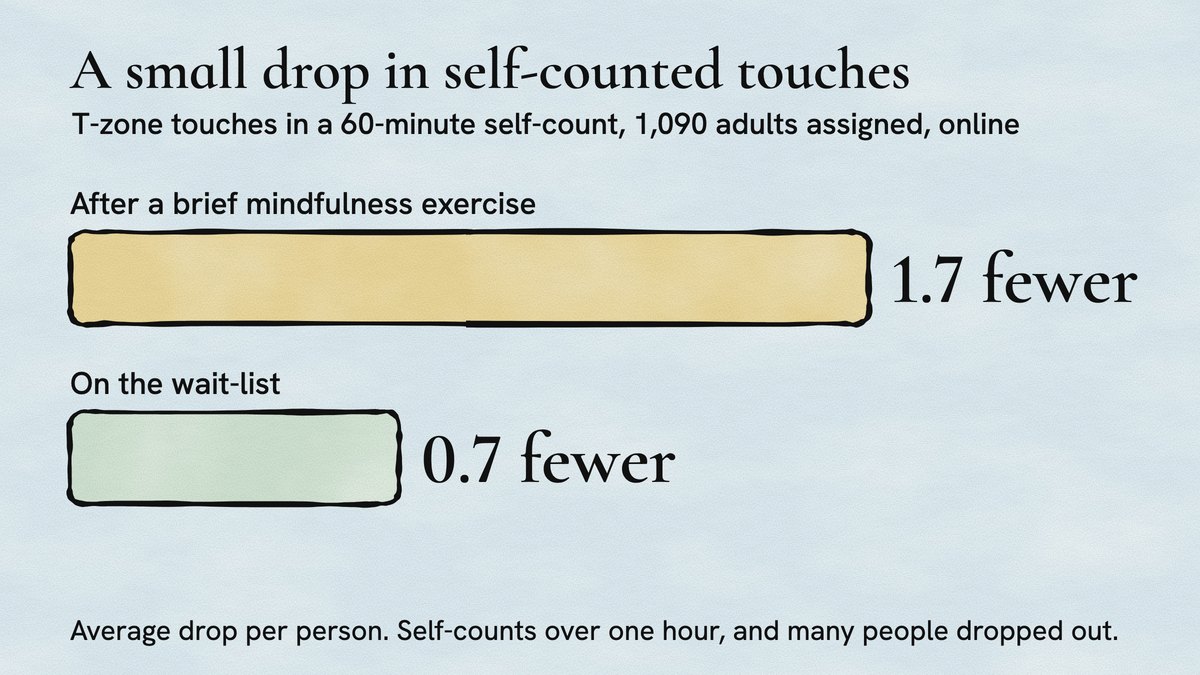
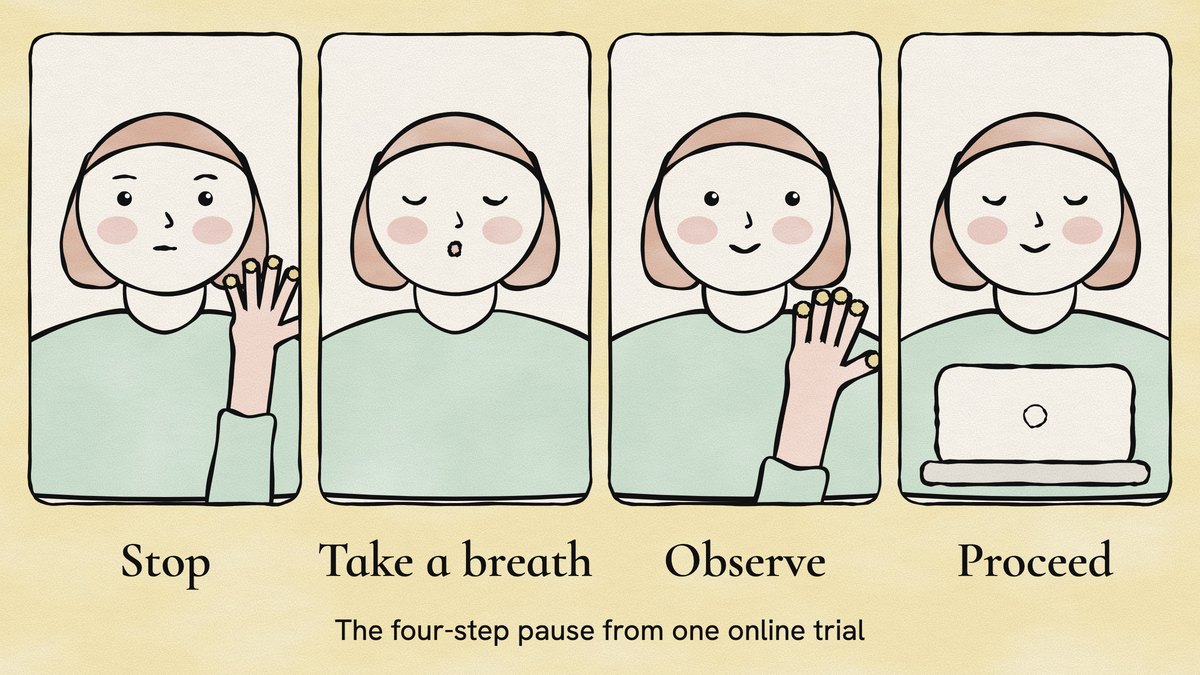
The largest trial was online. It assigned 1,090 adults who read and write Chinese to a wait-list or to a brief mindfulness exercise with four steps: stop, take a breath, observe, proceed. People counted their own touches for 60 minutes before and after. T-zone touches (eyes, nose and mouth, in most studies) fell by 1.7 on average in the exercise group and by 0.7 on the wait-list 5. The effect is small. It rests on self-counts over a single hour, many people dropped out, and the trial ran during the pandemic 5. Motivation may have been unusual then, which is our reading.
A smaller study used hardware. Eight healthy adults wore experimental vibrating bracelets. One bracelet didn't significantly lower touching across both hands. Two bracelets did, and the second round with two averaged 31 fewer "percentual points" than baseline, a unit the abstract doesn't define 6. Eight people in experimental bracelets tell you little about a Tuesday at your desk.
A message did less. A "Don't touch your face" message was tested against control messages in one undergraduate classroom over a 4-week period. The drop wasn't statistically significant, so call it no clear effect 7.
The firmest results come from nail biting, a neighbouring habit. A trial enrolled 30 adults who bit their nails at least 5 times a day, nearly every day. One group learned habit reversal: awareness training, a competing response (something else for the hands to do) and social support. The comparison group simply discussed their nail biting. Each group had 2 hours over 3 sessions, and 25 people finished. Nail length rose 22% with habit reversal and 3% in the comparison group. Five months later the gains stood at 19% and 0% 8.
A study of 21 people, 7 per group, ran for 4 weeks. A competing response and a bitter substance painted on the nails both improved nail length, the competing response most. Self-monitoring alone brought no significant improvement 9. Both active groups self-monitored too, and with so few people the result isn't settled.
Those small studies lean towards giving your hands something to do over keeping count.
What doesn't the research show?
None of this tells you what would happen over a normal working week. Nail biting isn't face touching, and that trial measured nail length, which is a different thing from counting bites 8. Habit reversal was delivered in sessions in that trial, so it doesn't tell you how a version run alone at your desk would do 8. The bracelet abstract reports nothing about what happens after the cues stop 6. We also found no trial showing that touching your face less means fewer infections. The mindfulness trial measured touching and left illness out 5.
What can you try at your desk today?
Each step says how much evidence stands behind it. Start with one.
- Count one hour. Keep a tally through a normal hour of work, as people did in the online trial 5. The number will be rough, and that trial's authors warn that counting may itself change what you do 5. Expect a number and little more: self-monitoring alone brought no significant improvement in the 21-person nail biting study 9.
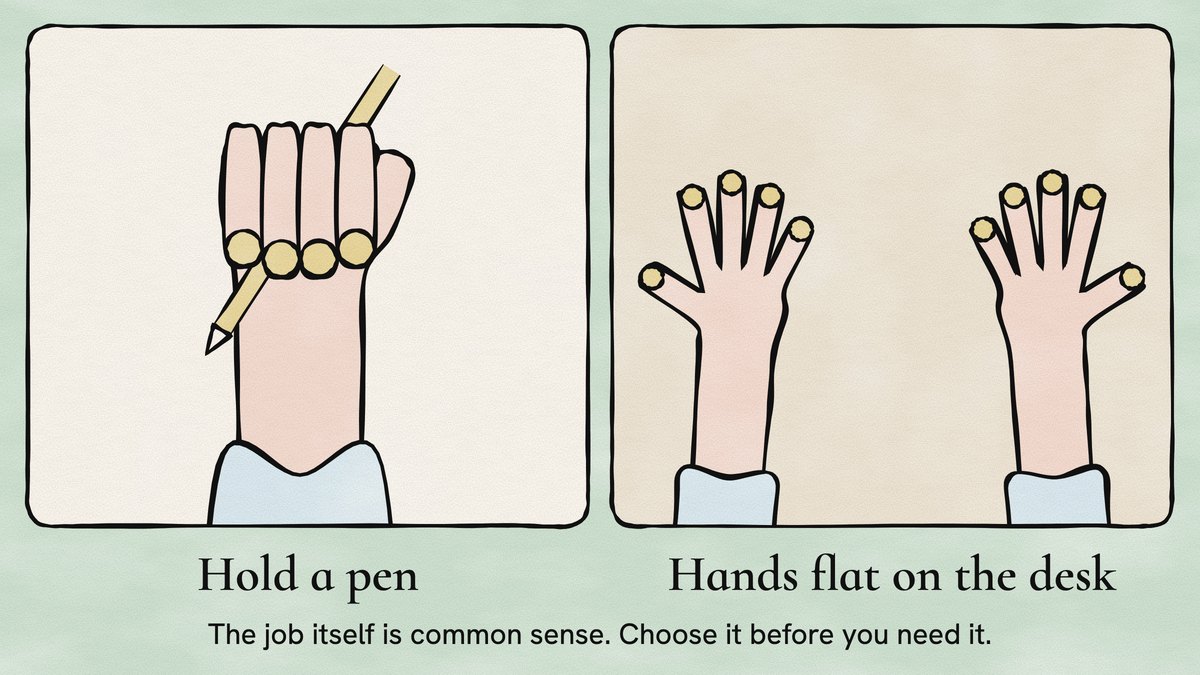
- Give your hands one job. Decide now what they do when you catch them near your face. This is the competing response from the nail biting studies 89, moved to face touching, where we found no test of it. The job itself is common sense: hold a pen, or rest your hands flat on the desk.
- Try the four-step pause. Stop, take a breath, observe, proceed 5. We found one test of it, online, with a small effect. Using it when you catch your hand, or before a long call, is common sense.
- Write down what came just before. Habit researchers link habits to physical settings and preceding actions 10, and applying their model to face touching is our inference. Noting the hard email or the long call is common sense, and it tells you when steps 2 and 3 matter.
- Keep the sticky note if you like it, and don't lean on it. The classroom message had no clear effect 7.
All of this depends on catching your hand, and most of it happens while your attention is on something else. So we built Mooo, an iPhone app that notices for you while you work or watch a film, and rings a soft cowbell when your hand stays near your face.
Sources
- Nicas M, Best D (2008). A study quantifying the hand-to-face contact rate and its potential application to predicting respiratory tract infection. Journal of Occupational and Environmental Hygiene 5(6):347-352. PubMed
- Elder NC, Sawyer W, Pallerla H, Khaja S, Blacker M (2014). Hand hygiene and face touching in family medicine offices: a Cincinnati Area Research and Improvement Group (CARInG) network study. Journal of the American Board of Family Medicine 27(3):339-346. PubMed
- Wilson M, van Allen ZM, Grimshaw JM, Brehaut JC, Durand A, Lalonde JF, Manuel DG, Michie S, West R, Presseau J (2023). Reducing touching eyes, nose and mouth ('T-zone') to reduce the spread of infectious disease: A prospective study of motivational, volitional and non-reflective predictors. British Journal of Health Psychology 28(4):893-913. PubMed
- Spille JL, Grunwald M, Martin S, Mueller SM (2021). Stop touching your face! A systematic review of triggers, characteristics, regulatory functions and neuro-physiology of facial self touch. Neuroscience and Biobehavioral Reviews 128:102-116. PubMed
- Tang J, Wang L, Luo T, Wu S, Wu Z, Chen J, Pan C, Wang Y, Liu Y, Luo Q, Guo X, Xie L, Zhou J, Sun Y, Chen W, Liao Y (2022). Effectiveness of a Brief Mindfulness-Based Intervention of "STOP touching your face" During the COVID-19 Pandemic: a Randomized Controlled Trial. Mindfulness 13(12):3123-3133. PubMed
- Virues-Ortega J, Pérez-Bustamante Pereira A, Martin N, Moeyaert M, Krause PA, Tarifa-Rodriguez A, Trujillo C, Sivaraman M (2023). Reducing face touching through haptic feedback: A treatment evaluation against fomite-mediated self-infection. Journal of Applied Behavior Analysis 56(3):549-564. PubMed
- Shi W, Mackert M, Kemp D, King AJ, Liu Y, Henson-García M, Yang J, Bouchacourt LM, Cahill AG (2024). "Don't touch your face"---Effectiveness of a health communication intervention on reducing face-touching behaviors. American Journal of Infection Control 52(12):1419-1424. PubMed
- Twohig MP, Woods DW, Marcks BA, Teng EJ (2003). Evaluating the efficacy of habit reversal: comparison with a placebo control. The Journal of Clinical Psychiatry 64(1):40-48. PubMed
- Silber KP, Haynes CE (1992). Treating nailbiting: a comparative analysis of mild aversion and competing response therapies. Behaviour Research and Therapy 30(1):15-22. PubMed
- Wood W, Neal DT (2007). A new look at habits and the habit-goal interface. Psychological Review 114(4):843-863. PubMed