How often do people touch their face?
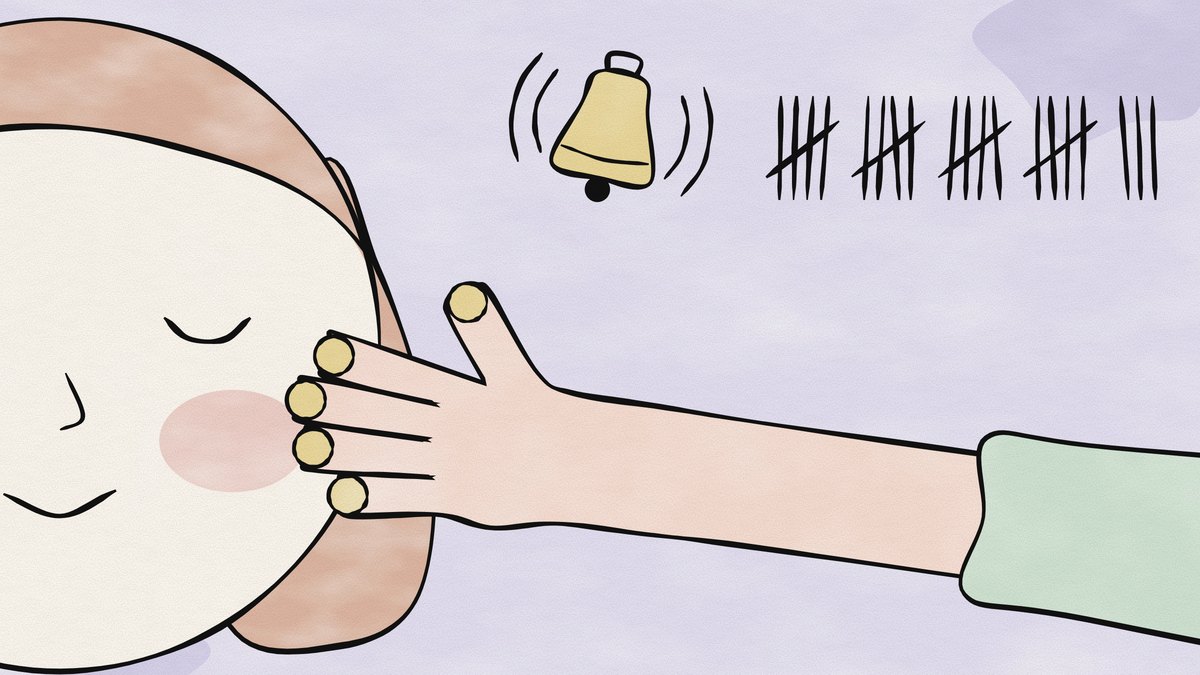
Somebody had to sit through 240 minutes of lecture video and count every time one of 26 medical students touched their face. The final tally was 2,346 1.
That comes to an average of 23 touches per student per hour 1, which by our arithmetic is about one every two and a half minutes. The students, at the University of New South Wales in Australia, knew they were being filmed for a behaviour study but not which behaviour. The two lectures had nothing to do with infection control 1.
Twenty-three is a good number to start with and a poor one to generalise from. It comes from one room, one type of person and one researcher doing the counting 1.
How many times an hour do people touch their face?
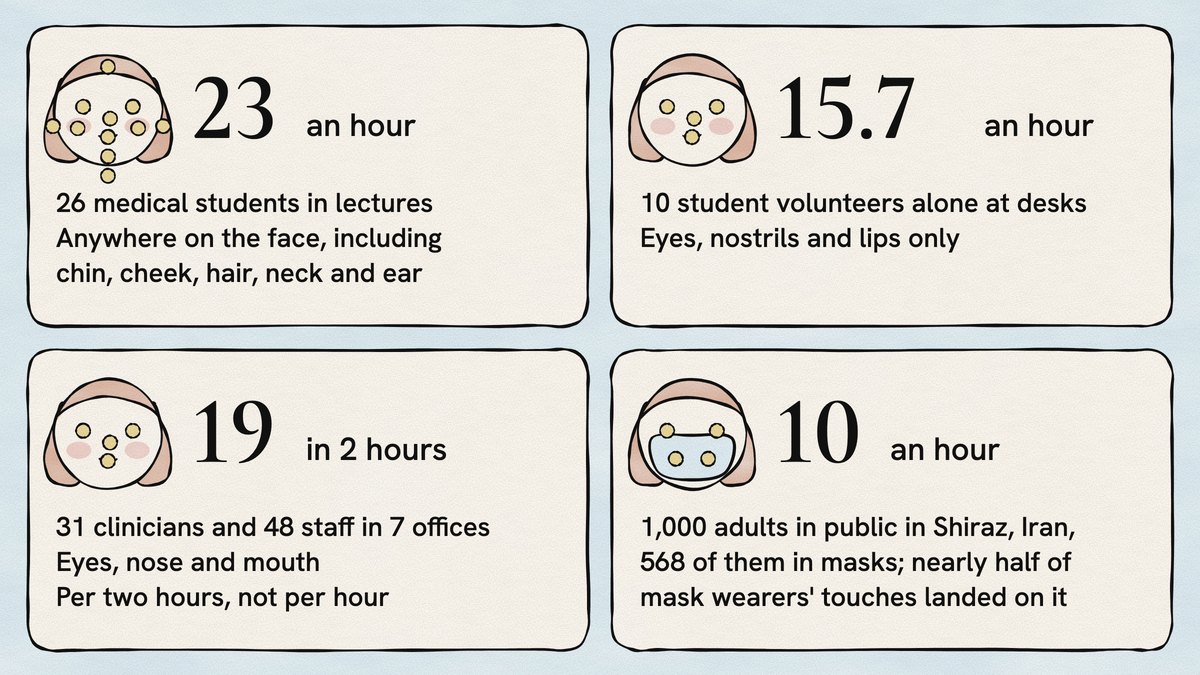
Every study gives a different answer, because every study watched different people and counted different parts of the face. These are the four we checked:
- 26 medical students in lectures: 23 touches an hour, anywhere on the face, including chin, cheek, hair, neck and ear 1.
- 10 student volunteers, each alone at a desk doing office-type work for 3 hours: 15.7 contacts an hour with the eyes, nostrils and lips only 2.
- 31 clinicians and 48 staff at 7 family medicine offices in the Cincinnati area: 19 touches of the eyes, nose and mouth in 2 hours 3.
- 1,000 adults in parks, banks, outpatient clinics and bus stations in Shiraz, Iran, 568 of them in masks: 10 touches an hour, and nearly half of mask wearers' touches landed on the mask 4.
These figures don't sit on one scale. The 15.7 can't go beside the 23, because it leaves out the chin, cheek, hair, neck and ear. The Cincinnati figure is per two hours, so it is easy to misread as 19 an hour.
Why do the counts differ so much?
Where you watch people may matter as much as what you count. A student in a lecture, a clinician between patients and a stranger at a bus station have different things to do with their hands.
Timing matters too. The Shiraz observers worked between April 22 and May 9, 2020, just after quarantine was lifted 4. The public was being advised not to touch their faces, so a normal rate may be higher. Each person was watched for 15 to 30 minutes and the result scaled up to an hour. People using a cellphone were left out 4, which removes a very common situation.
Being watched can lower counts as well. The desk volunteers knew they were on film, though they were told the tapes were for counting touches to a variety of surfaces 2. The Cincinnati abstract doesn't say how much its participants knew 3.
Is touching your face 23 times an hour normal?
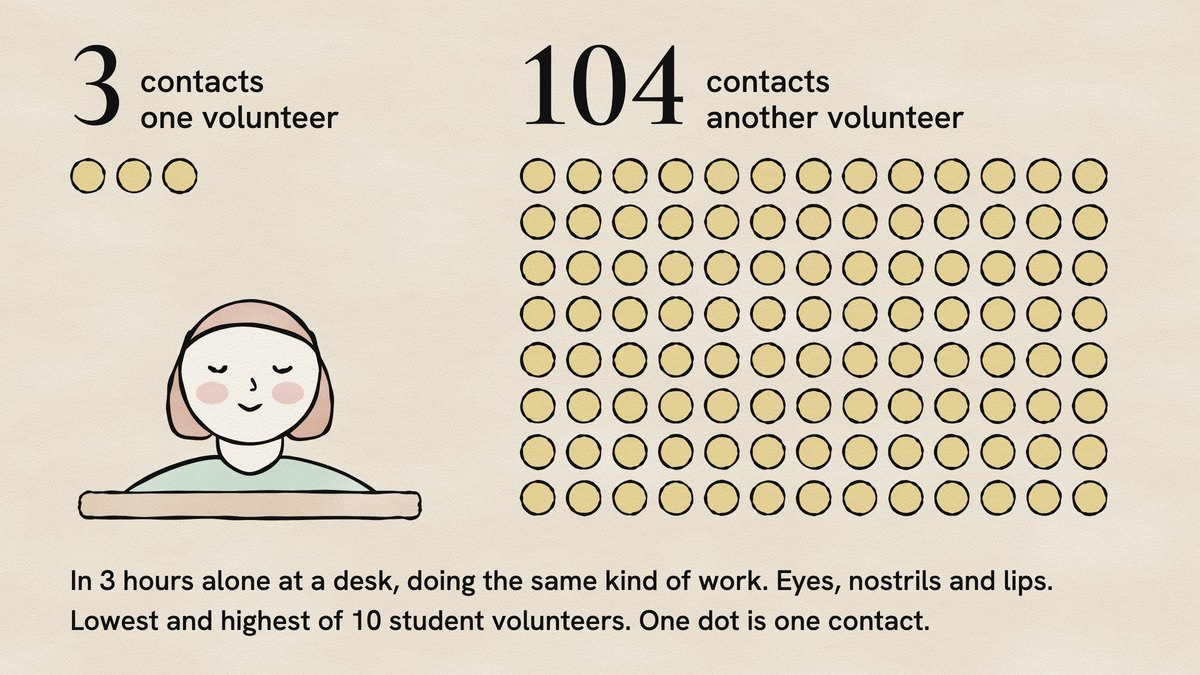
The average hides the most striking result in this research, which is how far apart individuals sit. In the desk study, one volunteer made 3 contacts in three hours and another made 104, in the same setting, doing the same kind of work 2. In the Cincinnati offices, the range ran from 0 to 105 in two hours. Clinicians touched significantly less often than staff, and the abstract doesn't say why 3.
Few people in that study abstained. Of the adults watched in Shiraz, 92% made at least one touch during the 15 to 30 minutes they were observed 4, and that was during a period of public advice against it.
So if you have caught yourself doing this, you are in ordinary company. An average can't tell you whether you sit nearer the 3 or the 104.
Can you guess your own number?
We wouldn't bet on your guess, because these movements often happen with little or no awareness 5. The four studies didn't test it directly. In the Cincinnati offices, how people rated their own prevention habits had no link with how often they touched their eyes, nose and mouth 3. That finding covers prevention habits in general, so it doesn't prove that people misjudge their own touching. It is still a reason to hold any self-estimate loosely.
The reliable method is the one the lecture study used. Film an hour of yourself working, then count. You will know what is being counted, which the students didn't, so expect your hands to be on their best behaviour.
What don't these studies show?
None of these studies watched anyone for a whole day. The longest ran to 240 minutes across two lectures 1, and the shortest gave each person 15 to 30 minutes 4. Daily totals do the rounds online. We leave them out because we could not find a study that counted one. Stretching a lecture into a full day also assumes the rest of your day looks like a lecture.
Nobody here was filmed on a sofa, scrolling or watching a film. The people in these studies were in lectures, at desks, in clinics and out in public, and the Shiraz team removed phone users on purpose 4. The hours many of us wonder about most are the hours nobody in these papers counted.
Your own number is out there somewhere, and it is hard to find because so many touches slip past unnoticed. So we built something that notices when your hand lingers while you work or watch a film: Mooo rings a soft cowbell when your hand stays near your face. It won't give you that number, because brief touches don't count.
Sources
- Kwok YL, Gralton J, McLaws ML (2015). Face touching: a frequent habit that has implications for hand hygiene. American Journal of Infection Control 43(2):112-114. PubMed
- Nicas M, Best D (2008). A study quantifying the hand-to-face contact rate and its potential application to predicting respiratory tract infection. Journal of Occupational and Environmental Hygiene 5(6):347-352. PubMed
- Elder NC, Sawyer W, Pallerla H, Khaja S, Blacker M (2014). Hand hygiene and face touching in family medicine offices: a Cincinnati Area Research and Improvement Group (CARInG) network study. Journal of the American Board of Family Medicine 27(3):339-346. PubMed
- Shiraly R, Shayan Z, McLaws ML (2020). Face touching in the time of COVID-19 in Shiraz, Iran. American Journal of Infection Control 48(12):1559-1561. PubMed
- Grunwald M, Weiss T, Mueller S, Rall L (2014). EEG changes caused by spontaneous facial self-touch may represent emotion regulating processes and working memory maintenance. Brain Research 1557:111-126. PubMed