How long does it take to break a habit?
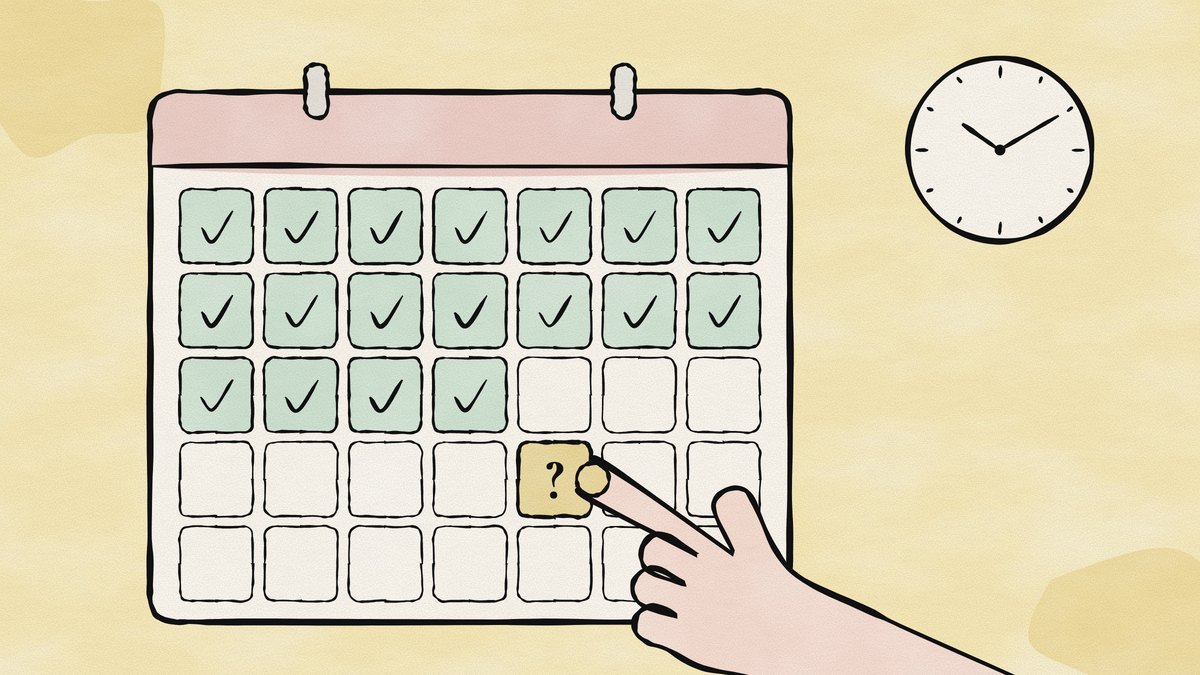
A 12-week study of how habits form recruited 96 volunteers, and each one chose a behaviour to take up 1. Each chose an eating, drinking or activity behaviour and repeated it daily in the same context, such as after breakfast.
That one detail decides how much the study can tell you about nail biting, hair twirling or a hand that keeps drifting to your face.
What do the 18 to 254 days measure?
The range of 18 to 254 days describes how long people took to get close to the most automatic a new, wanted behaviour would ever feel 1. Each volunteer rated the behaviour daily on a habit scale, and the researchers fitted a curve to each person's scores. The figure marks the point where a person reached 95% of the level their curve was heading for 1.
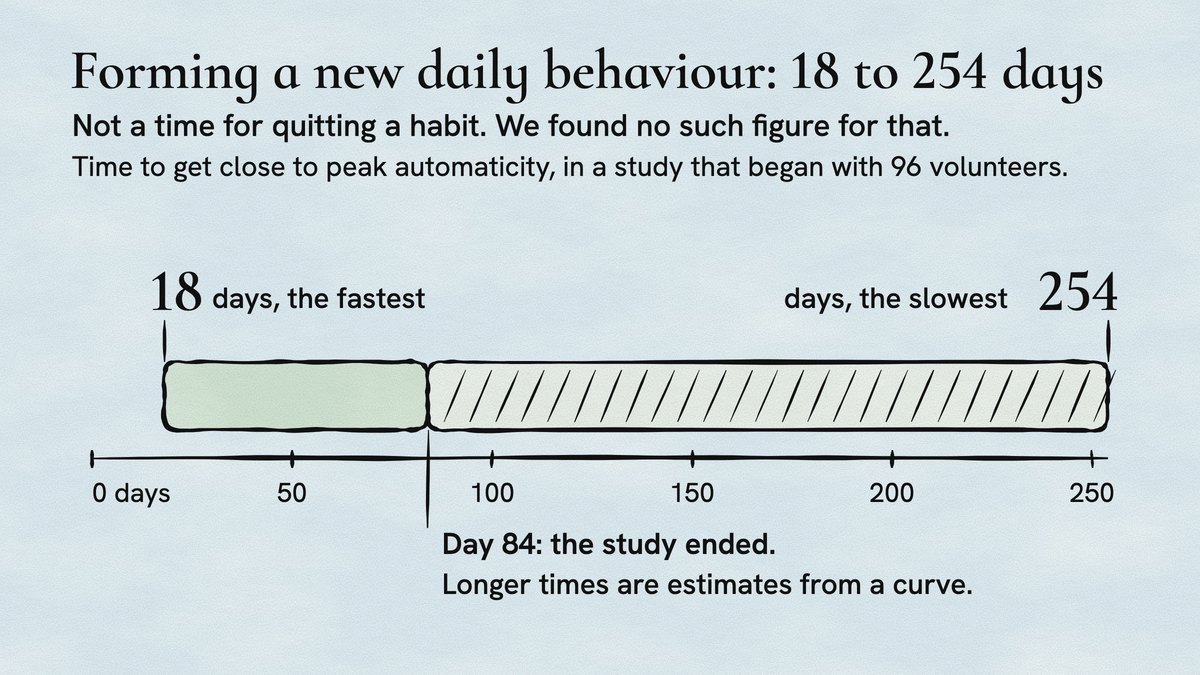
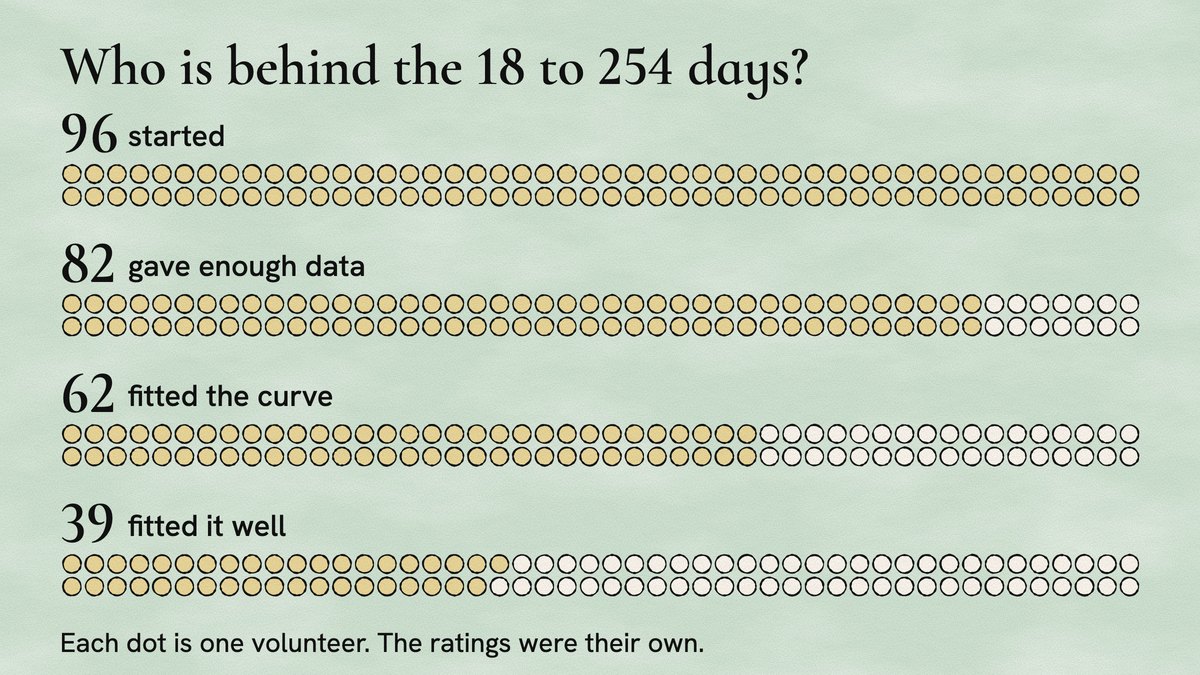
Three cautions come with it. Of the 96 who started, 82 gave enough data, the curve fitted for 62, and it fitted well for 39 1. The study lasted 84 days, so a time like 254 days is an estimate from the curve, and no one watched it happen. The ratings were also the volunteers' own 1.
The range does count against one popular number. As a rule for everyone, "21 days" has no support in the research we checked. It sits near the fastest end of a very wide spread, and the authors themselves concluded that forming a habit "can take a very long time" 1.
Can you run that number backwards for quitting?
We found no equivalent data on how long it takes to lose an unwanted hand habit, and these numbers shouldn't be borrowed for the job. Starting a behaviour you want and losing one you don't are different questions, and we found only the first timed this way.
Theory gives a reason for caution. One model of habits says the link between a setting and a response builds slowly. That link does "not shift appreciably with current goal states or infrequent counterhabitual responses" 2. In plain words, wanting to stop and resisting now and then may leave the habit about where it was. That paper is a model of habits in general, so applying it to hands is our inference.
Why is a hand habit so hard to time?
Our guess is that a hand habit is hard to see, which makes it hard to count. In an interview study of 339 young adults, 92.2% described nail biting as automatic; the abstract says "subjects", most likely meaning the biters 3. A volunteer can rate a new behaviour every day because they do it on purpose. Counting something that happens outside your attention is another matter. The largest face touching trial we found relied on people counting themselves for one hour, and its authors say that makes the results "less reliable" 4. A clock needs a clear start and a clear finish, and this habit offers neither.
Is a habit gone when you stop doing it?
A habit you're holding back and a habit that has faded can look identical from the outside. In two diary studies, bad habits were controlled most effectively by vigilant monitoring, which means thinking "don't do it" and watching for slipups. A follow-up experiment found that this worked by heightening cognitive control, with the strength of the habit in memory unchanged 5.
The diaries were self-reported and the abstract doesn't single out hand habits 5. If it applies, though, a calm month could mean your control is strong while the habit underneath has barely moved. We found no test of that in hand habits.
What do nail biting studies say about time?
The closest thing to a timeline for a hand habit is two snapshots. In a study of 21 people, 7 per group, both active methods had improved nail length after 4 weeks, while self-monitoring alone showed no significant improvement 6. A trial enrolled 30 adults who bit their nails at least 5 times a day, nearly every day. After 2 hours of habit reversal over 3 sessions, nail length was up 22%, against 3% for a comparison group. Five months later the gains stood at 19% and 0% 7.
Each number shows a change at the moment someone looked. Neither study tells you how long the change took to arrive or when anyone could call it finished. Both measured nails instead of bites, and the second was delivered in sessions, so it doesn't describe doing this alone 7.
What can you do without a number?
You can't plan around a date, so plan around a measurement.
- Choose something to measure. Nail length was the outcome in both nail biting studies 67, and for face touching you can count one hour, as people did in the online trial 4. Expect a rough figure. Repeating the same hour at the same time of day is common sense.
- Set one review date. The 21-person study ran for 4 weeks 6. Using that as a first check is common sense, and it says nothing about when you'd be done.
- Decide what your hands do instead. A competing response, meaning something else for the hands to do, was part of what helped in both studies 67. The result isn't settled, and we found no test of it on face touching.
- Read a slip as information. For people forming a new habit, missing one opportunity "did not materially affect" the process 1. We found no check of this for losing a habit, so here it's common sense.
Hands do most of this without you noticing, so we built Mooo. While you work or watch a film, it notices when your hand stays near your face and rings a soft cowbell.
Sources
- Lally P, van Jaarsveld CHM, Potts HWW, Wardle J (2010). How are habits formed: Modelling habit formation in the real world. European Journal of Social Psychology 40(6):998-1009. DOI
- Wood W, Neal DT (2007). A new look at habits and the habit-goal interface. Psychological Review 114(4):843-863. PubMed
- Pacan P, Grzesiak M, Reich A, Kantorska-Janiec M, Szepietowski JC (2014). Onychophagia and onychotillomania: prevalence, clinical picture and comorbidities. Acta Dermato-Venereologica 94(1):67-71. PubMed
- Tang J, Wang L, Luo T, Wu S, Wu Z, Chen J, Pan C, Wang Y, Liu Y, Luo Q, Guo X, Xie L, Zhou J, Sun Y, Chen W, Liao Y (2022). Effectiveness of a Brief Mindfulness-Based Intervention of "STOP touching your face" During the COVID-19 Pandemic: a Randomized Controlled Trial. Mindfulness 13(12):3123-3133. PubMed
- Quinn JM, Pascoe A, Wood W, Neal DT (2010). Can't control yourself? Monitor those bad habits. Personality & Social Psychology Bulletin 36(4):499-511. PubMed
- Silber KP, Haynes CE (1992). Treating nailbiting: a comparative analysis of mild aversion and competing response therapies. Behaviour Research and Therapy 30(1):15-22. PubMed
- Twohig MP, Woods DW, Marcks BA, Teng EJ (2003). Evaluating the efficacy of habit reversal: comparison with a placebo control. The Journal of Clinical Psychiatry 64(1):40-48. PubMed