Hair twirling in adults: what we know about the habit
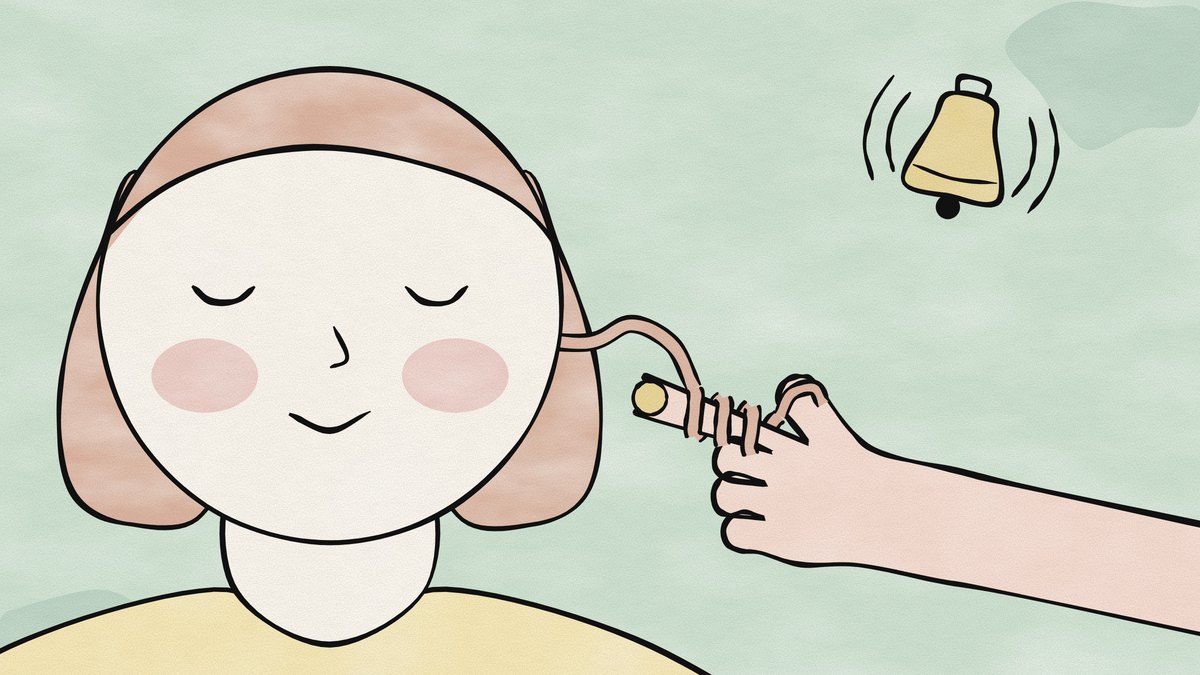
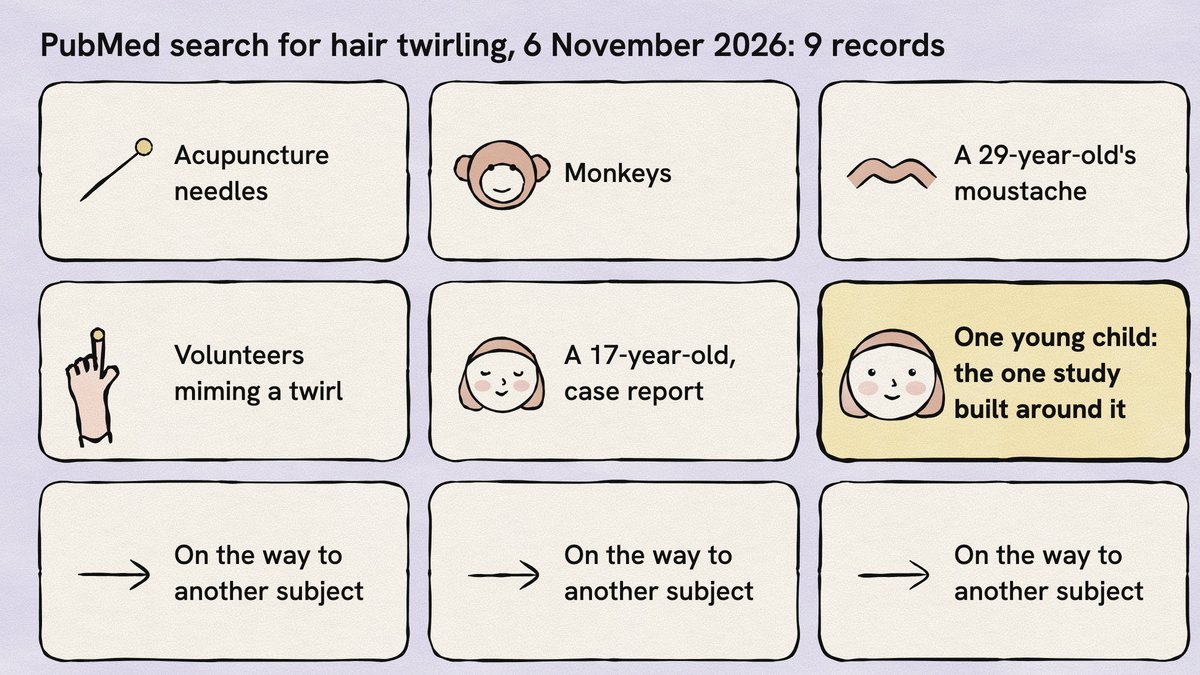
Type hair twirling into PubMed, the main index of medical research, and 9 records come back 1. One is about acupuncture needles. One is about monkeys. One is a case report on a 29-year-old's moustache. In another, volunteers learned to mime twirling in response to a picture of long hair. Most of the others reach twirling on the way to another subject, such as hair pulling.
Only one record is a study built around hair twirling, and its participant is one young child 2. A case report also describes a 17-year-old whose repeated twirling left patchy hair loss 1. None studies an adult twirling the hair on their head.
So this is a short post. Anything longer would be us guessing in a lab coat.
PubMed isn't all of science, and a study could sit under other words. The next section is the best example we found.
What do we know about hair twirling in adults?
The closest group evidence we found is a 1996 study whose abstract never mentions twirling. Researchers secretly filmed 44 people in three conditions, anxious, bored and neutral, and scored five classes of habit. Hair and face manipulation rose in the anxiety condition, and object manipulation rose in the bored one 3.
The authors called the study preliminary. The abstract doesn't define hair manipulation or give anyone's age, so we can't say how much of it was twirling, or that everyone filmed was an adult. If the finding holds, and if it covers twirling, hands would seem to go to hair under tension more than out of boredom. Those are two large ifs.
Why isn't hair pulling research in this post?
Hair pulling has far more research, and the two can be linked: the one child study calls twirling "a frequently occurring precursor to hair pulling" 2. That link doesn't show that findings on pulling apply to twirling, so they stay out of this post. The same goes for nail biting, which has small trials of its own. We won't lend them to twirling.
This also gives you a useful test for anything else you read. If an article tells you what your twirling says about you, ask to see the adult study. We couldn't find one.
Why might a hand keep going back to hair?
General habit theory offers one possible answer, and using it here is our inference. In Wood and Neal's model, habits grow from gradual learning between a response and its setting, such as a place or the action just before it. Once formed, the setting can trigger the response with no goal in between 4. We found no test of that on twirling. It would mean the sofa and the lecture hall matter more than any hidden meaning.
Should you worry about it?
We found no study of adults who twirl the hair on their head, so we can't call it harmful or harmless. Two case reports in the search did link repeated twirling to hair trouble: patchy hair loss in a 17-year-old, and possible breakage in a 29-year-old's moustache 1. If it doesn't bother you and your hair looks fine, nothing we read says you have to stop. If it has turned into pulling, if your hair is thinning or breaking, or if it is bothering you, a doctor is the right person to ask.
What can you try?
Everything here is common sense. We found no test of any of it in adults who twirl.
- For one day, notice where it happens: a film, a call, a page you are reading.
- Tie your hair back for those situations, so a hand finds less to wind.
- Give that hand a job, such as holding a pen or a mug.
- When you catch yourself, ask whether you feel tense or bored. It won't settle anything, but it is one more adult than the literature has.
If your twirling happens while you work or watch a film, we built something that notices: Mooo rings a soft cowbell when a hand stays near your face or in the hair beside your head. We found no study of what a cowbell does for twirling, so the cowbell is all we can promise.
Sources
- PubMed search for hair twirling, entered without quotation marks, run on 6 November 2026. In quotation marks, the exact phrase returned 5 records. Search results
- Deaver CM, Miltenberger RG, Stricker JM (2001). Functional analysis and treatment of hair twirling in a young child. Journal of Applied Behavior Analysis 34(4):535-538. PubMed
- Woods DW, Miltenberger RG (1996). Are persons with nervous habit nervous? A preliminary examination of habit function in a nonreferred population. Journal of Applied Behavior Analysis 29(2):259-261. PubMed
- Wood W, Neal DT (2007). A new look at habits and the habit-goal interface. Psychological Review 114(4):843-863. PubMed