Can a reminder stop you touching your face?
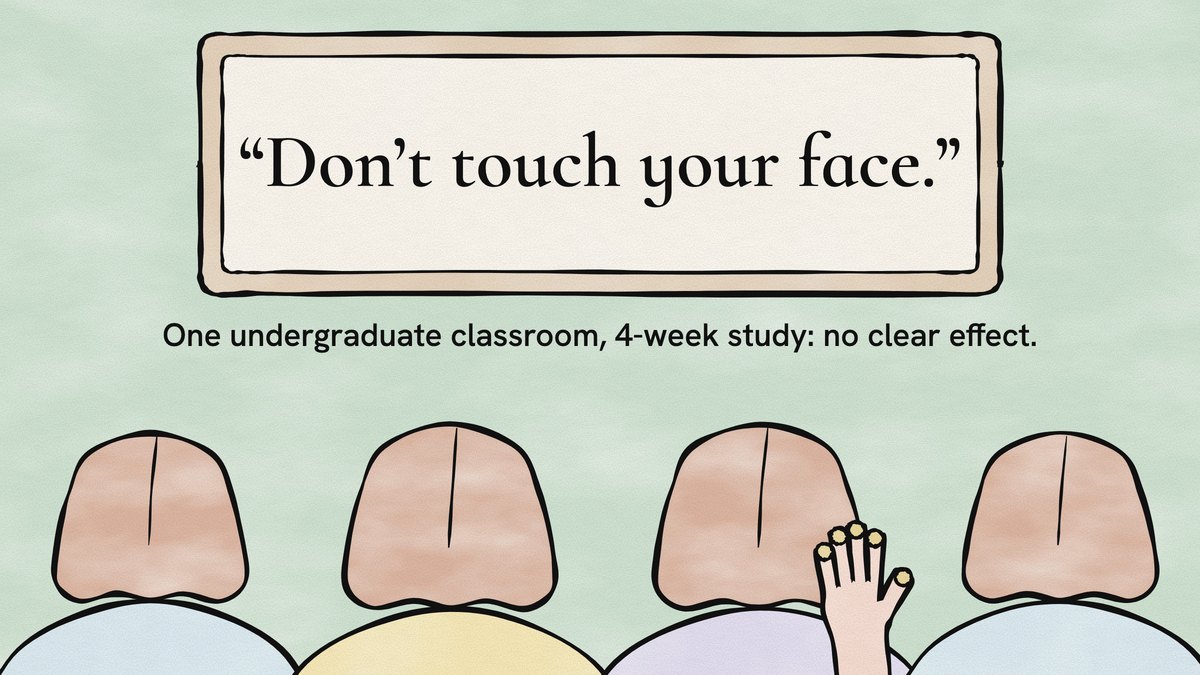
During a 4-week study, one undergraduate classroom displayed either control messages or messages meant to cut face touching, and one of those left little room for doubt. It said "Don't touch your face." On average, students touched their faces less while it was up. The decrease was not statistically significant, so the fair summary is no clear effect 1. The paper's conclusion sounds more hopeful than its data, and we'd rather give you the data.
That classroom is a good small picture of the whole subject. Reminders make sense on paper. The measurements are untidier, and some of them point the other way.
Why would a reminder help at all?
A hand that reaches your face without asking gives you nothing to say no to. One 2014 brain study describes these movements as "frequently accomplished with little or no awareness" 2. Habit researchers describe something similar in general terms: once a habit has formed, the setting triggers the response "without a mediating goal" 3. Applying their model to face touching is our inference.
A reminder, then, tries to put a moment of attention where there wasn't one. That is a hypothesis, and researchers have tested it in several forms.
What happened when researchers tested it?
"Reminder" covers at least five different things, and they did not behave alike.
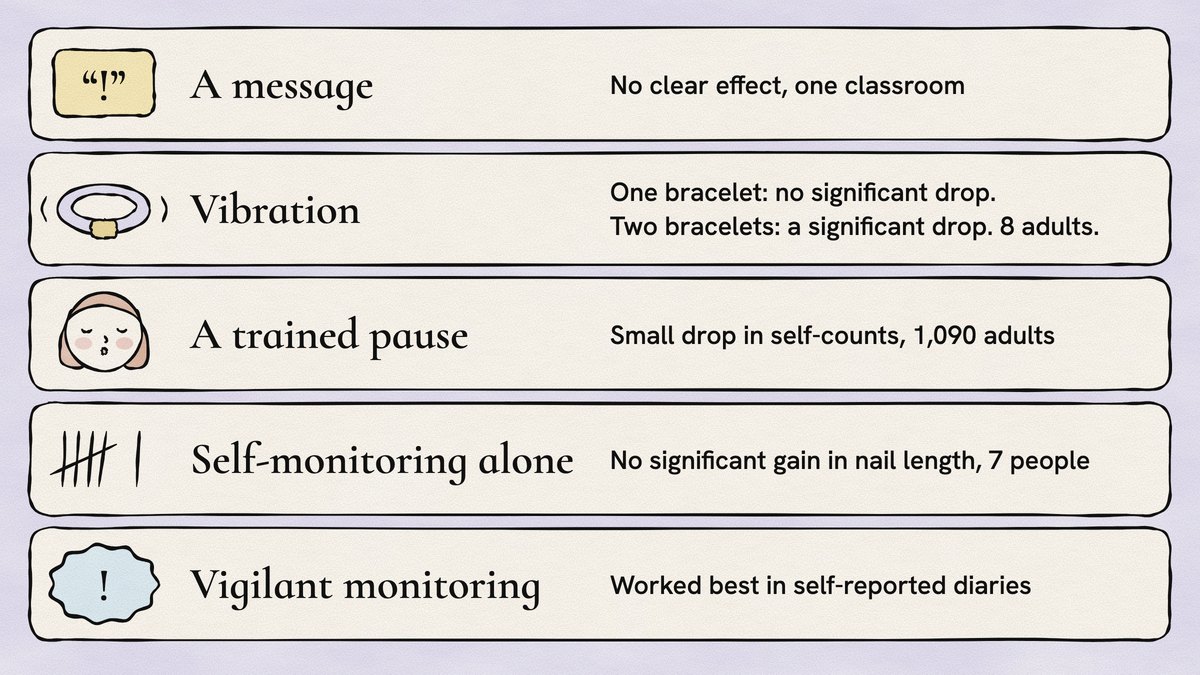
The message is the classroom above. A companion online experiment with 998 US adults tested nine messages, but it measured perceptions and intentions. Only the classroom watched real touching 1.
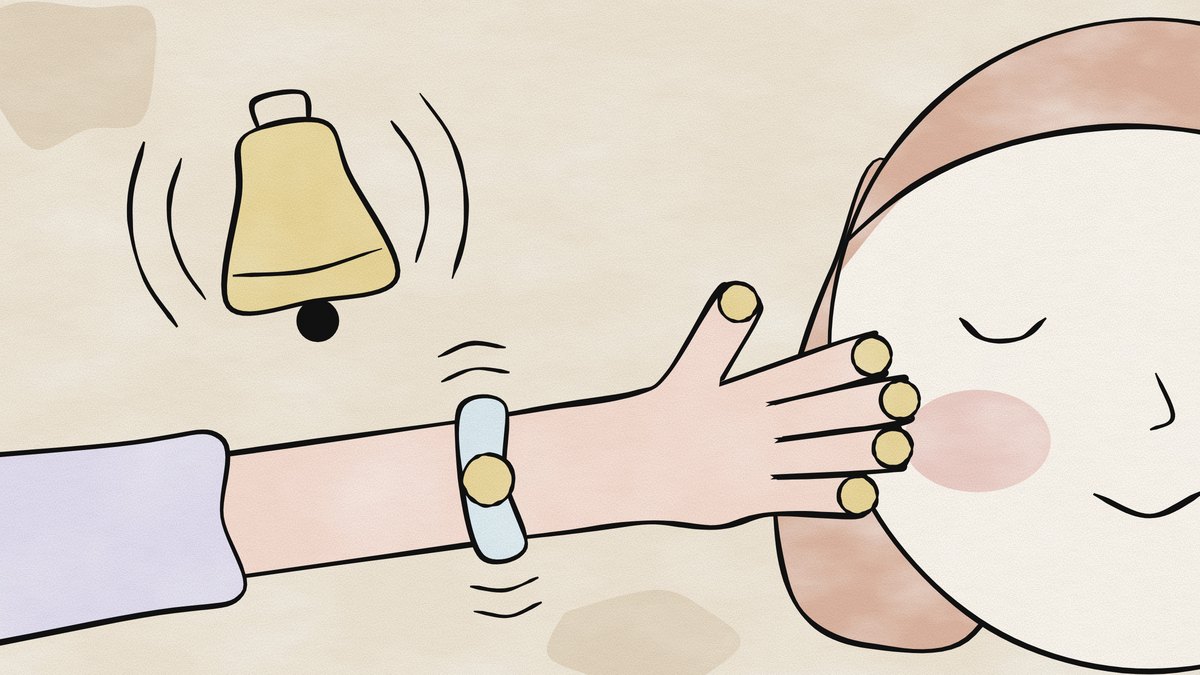
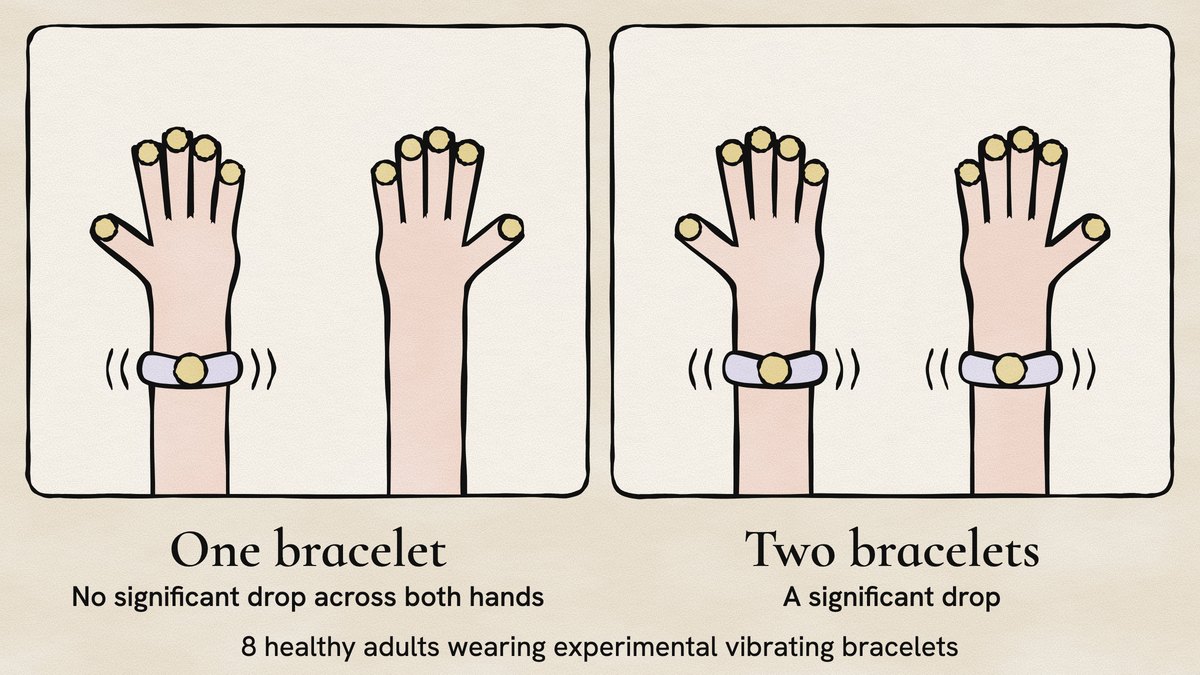
Vibration gave the most striking split. Eight healthy adults wore experimental bracelets that delivered computer-controlled vibrating cues. One bracelet produced no significant drop across both hands. Two bracelets did, and the second round with two averaged 31 fewer "percentual points" than baseline, a unit the abstract doesn't define 4. Within one study of 8 people, the same idea fell short with one bracelet and reached significance with two.
A trained pause showed a small effect that deserves caution. An online trial assigned 1,090 adults who read and write Chinese to a wait-list or to a brief mindfulness exercise: stop, take a breath, observe, proceed. Afterwards, 73.0% of the exercise group and 79.4% of the wait-list touched their T-zone (eyes, nose and mouth, in most studies) during a 60-minute self-count. Touches fell by 1.7 on average against 0.7 5. Everyone counted for themselves, and the authors write that this "makes the results less reliable because we do not know exactly what the observed decrease means" 5.
Self-monitoring on its own pointed the other way. In a nail biting study of 21 people, 7 of them self-monitored for 4 weeks and did nothing else. They saw no significant improvement in nail length 6. Seven people is very few, and a study that size can miss a real effect.
Watching yourself came out well, in a very different kind of study. Two diary studies found that bad habits were controlled most effectively through "vigilant monitoring": thinking "don't do it" and watching carefully for slipups 7. Those diaries were self-reported, the abstract doesn't single out hand habits, and the monitoring came from inside the person's head. They don't show that an outside signal works.
Why did awareness help in some studies and not in others?
We found no study that tested that directly, so what follows is our reading. The first explanation is dull and probably large: these studies measured different habits with different yardsticks, including nail length, video, self-counts and diaries.
The second is more interesting. In the nail biting work, every group that improved had added something to the noticing. In the 21-person study, the two groups that gained also self-monitored. One added a competing response (something else for the hands to do), the other a bitter substance on the nails 6. In a trial of 30 adults, awareness training came packaged with a competing response and social support. Nail length rose 22%, against 3% for a comparison group that simply discussed their nail biting 8. That design can't show which part did the work. Still, the only group built on noticing alone showed no significant gain 6.
There's a third clue. A follow-up experiment found that vigilant monitoring aided habit control by heightening cognitive control, and it left the strength of the habit in memory unchanged 7. If that applies to hands, and we found no test of it, watching would hold a habit back without weakening it.
What could you try today?
Three small experiments follow from this. We found no test of any of them at work.
- Attach an action to whatever reminder you already use. Decide in advance what your hands do when you notice them. Competing responses were tested in nail biters 68, the result isn't settled, and moving it to face touching is our inference.
- Try the pause for one hour. Stop, take a breath, observe, proceed 5. Count your touches before and after, and expect a rough number.
- Choose the hour you trust yourself least and watch for slips on purpose, thinking "don't do it" 7. The diary studies covered bad habits in general. Choosing the hour is common sense.
What can't these studies tell you?
None of the studies in this post tested a sound, or a camera that watches for hands. The closest, the bracelet study, used vibrating cues on the hands of 8 adults 4. A finding about one kind of reminder doesn't carry over to another.
They also say little about the long run. The pause was measured over a single hour 5, the 21-person nail biting study lasted 4 weeks 6, and the bracelet abstract reports nothing about what happens once the cues stop 4. The pause trial also measured touching and left illness out 5.
We should declare an interest: hands do most of this while your attention is on something else, so we built Mooo, an iPhone app. It notices a hand staying near your face while you work or watch a film, and rings a soft cowbell.
Sources
- Shi W, Mackert M, Kemp D, King AJ, Liu Y, Henson-García M, Yang J, Bouchacourt LM, Cahill AG (2024). "Don't touch your face"---Effectiveness of a health communication intervention on reducing face-touching behaviors. American Journal of Infection Control 52(12):1419-1424. PubMed
- Grunwald M, Weiss T, Mueller S, Rall L (2014). EEG changes caused by spontaneous facial self-touch may represent emotion regulating processes and working memory maintenance. Brain Research 1557:111-126. PubMed
- Wood W, Neal DT (2007). A new look at habits and the habit-goal interface. Psychological Review 114(4):843-863. PubMed
- Virues-Ortega J, Pérez-Bustamante Pereira A, Martin N, Moeyaert M, Krause PA, Tarifa-Rodriguez A, Trujillo C, Sivaraman M (2023). Reducing face touching through haptic feedback: A treatment evaluation against fomite-mediated self-infection. Journal of Applied Behavior Analysis 56(3):549-564. PubMed
- Tang J, Wang L, Luo T, Wu S, Wu Z, Chen J, Pan C, Wang Y, Liu Y, Luo Q, Guo X, Xie L, Zhou J, Sun Y, Chen W, Liao Y (2022). Effectiveness of a Brief Mindfulness-Based Intervention of "STOP touching your face" During the COVID-19 Pandemic: a Randomized Controlled Trial. Mindfulness 13(12):3123-3133. PubMed
- Silber KP, Haynes CE (1992). Treating nailbiting: a comparative analysis of mild aversion and competing response therapies. Behaviour Research and Therapy 30(1):15-22. PubMed
- Quinn JM, Pascoe A, Wood W, Neal DT (2010). Can't control yourself? Monitor those bad habits. Personality & Social Psychology Bulletin 36(4):499-511. PubMed
- Twohig MP, Woods DW, Marcks BA, Teng EJ (2003). Evaluating the efficacy of habit reversal: comparison with a placebo control. The Journal of Clinical Psychiatry 64(1):40-48. PubMed